BELIZE AT THE CROSSROADS: WHILE THE REGION REDRAWS ITS TOURISM MAP, ARE WE BUILDING A NETWORK — OR LOSING CONNECTIONS?
NATIONAL PERSPECTIVE BELIZE — SPECIAL FEATURE
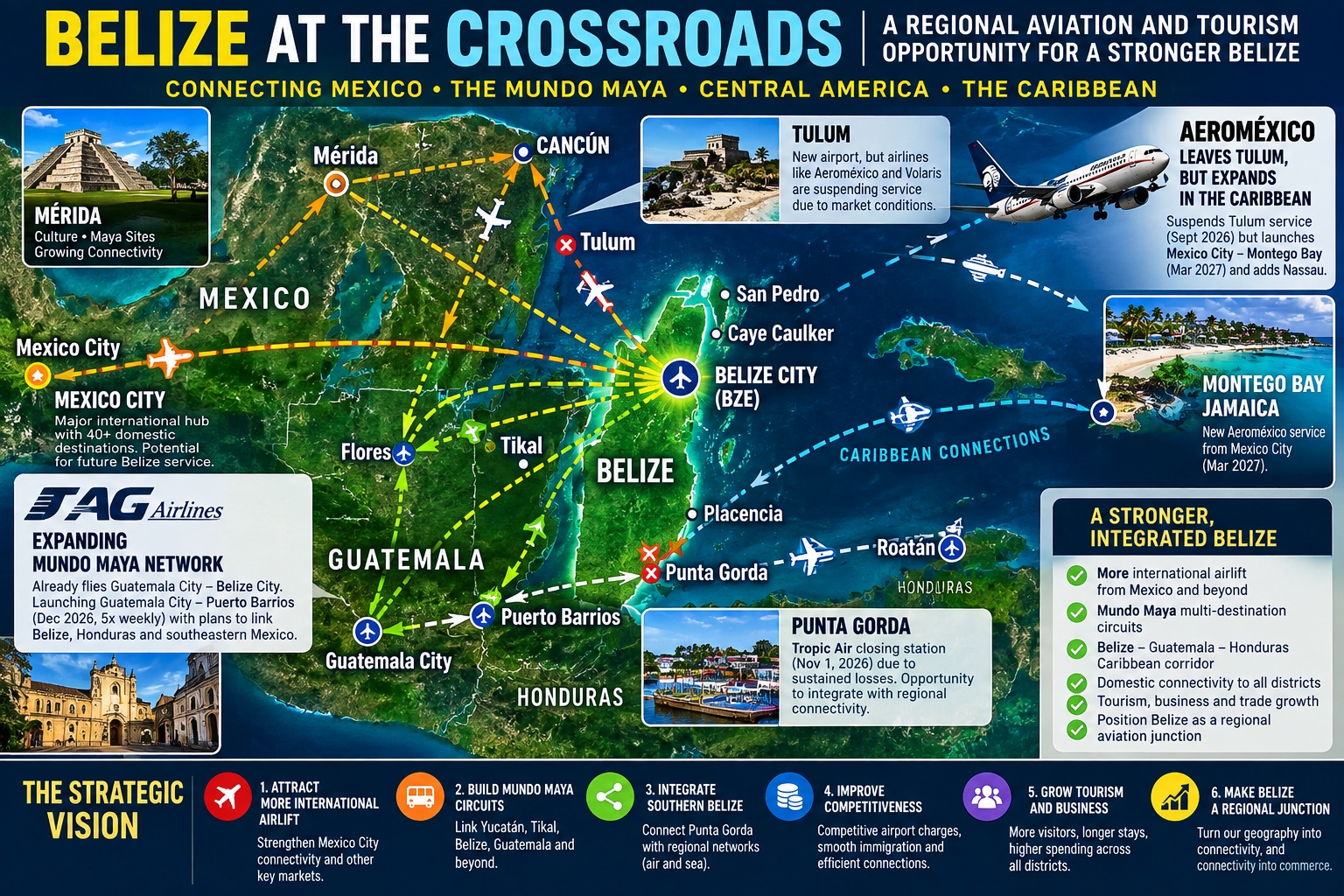
Belize City: Friday 2nd October 2026: Something much larger than the closure of an airline station may be unfolding around Belize.
- Look north toward Mexico.
- Look west toward Guatemala.
- Look east across the Caribbean toward Jamaica.
Then look south toward Punta Gorda.
Taken separately, recent airline developments can appear unrelated: an airline suspends a route here, another opens a route there, a domestic carrier withdraws from a small market, and a regional airline searches for new passengers.
- Put them on the same map, however, and another picture begins to emerge.
The tourism and aviation architecture surrounding Belize is moving.
- The question Belize should be asking is whether we intend merely to watch that movement — or position ourselves inside it.
TULUM: A NEW AIRPORT DOES NOT GUARANTEE AN AIRLINE MARKET
- Mexico's experience provides the first warning.
- Tulum received a major new international airport intended to support one of the Mexican Caribbean's most recognizable tourism destinations.
- Yet airlines have been reassessing the market.
- Aeroméxico suspended its Tulum operation at the end of September 2026 amid changing market conditions. Volaris has also announced the suspension of its Tulum service beginning in January 2027.
The lesson should not be reduced to whether Tulum tourism is "failing."
- Airlines follow passengers, yields, operating costs and network opportunities.
- An airport can be built.
- Runways can be paved.
- Terminals can be inaugurated.
But infrastructure by itself cannot guarantee commercially sustainable airline traffic.
- That lesson should resonate strongly in Belize.
AEROMÉXICO LEAVES TULUM — BUT NOT THE CARIBBEAN
Here is where the regional picture becomes more interesting.
- Aeroméxico's withdrawal from Tulum does not represent a wholesale retreat from Caribbean expansion.
- The airline is opening Mexico City–Montego Bay, Jamaica, with service beginning in March 2027.
- Aeroméxico's own booking system is already displaying Mexico City–Montego Bay itineraries for April 2027.
Jamaica therefore provides an important contrast.
- While one Mexican Caribbean destination loses Aeroméxico capacity, another Caribbean destination is positioning itself to receive Mexican passengers — and, equally important, passengers connecting through Mexico City's enormous aviation network.
This does not mean the Tulum aircraft was simply moved to Jamaica.
Airline network planning is considerably more complicated than that.
But strategically the message is unmistakable: Airline capacity moves toward markets where carriers believe they can build viable traffic.
That raises an obvious question for Belize.
- Why shouldn't Belize be competing for some of that traffic?
- Belize has been talking about the Mexican tourism market for years.
- Tourism Minister Anthony Mahler said as far back as 2024 that the Mexican visitor market had grown significantly and that Belize was working toward securing direct air connectivity with Mexico.
Two years later, the opportunity deserves another examination.
Not simply: Can Belize get another flight?
But: What would Belize have to build commercially around that flight to make Mexico City–Belize sustainable?
- That means Mexican tourists.
- Business travellers.
- Belizeans travelling into Mexico.
- Connecting passengers.
- Mundo Maya tourism.
- European and Asian passengers connecting through Mexico City.
- And Mult destination visitors who could combine Mexico, Belize and Guatemala in a single journey.
That is aviation strategy.
NOW LOOK WEST: GUATEMALA IS THINKING REGIONALLY
TAG Airlines provides the other piece of this puzzle.
- TAG already connects Guatemala and Belize.
- But the Guatemalan regional carrier has been developing a broader concept around the Mundo Maya, including stronger connectivity between Guatemala and southeastern Mexico.
- TAG Commercial Director Francisco José Pahul Merino has publicly described an integrated tourism vision linking destinations such as Mérida and Chichén Itzá with Flores, Tikal and Guatemala's tourism attractions.
The concept is straightforward: Stop selling neighbouring destinations as isolated islands.
Sell the region as a circuit.
- A traveller arriving in Mérida should be able to continue toward Flores.
- A visitor to Tikal should be able to continue toward Belize.
- A visitor to Belize should be able to connect onward through Central America.
That is where geography suddenly becomes economic opportunity.
- Belize sits almost in the middle of this emerging tourism space.
- Cancún and the Riviera Maya are north of us.
- Mérida and Yucatán are northwest.
- Flores and Tikal are west.
- Puerto Barrios and Guatemala's Caribbean coast are southwest.
- Roatán and Honduras are southeast.
And Belize possesses something extraordinary directly between them:
- the Belize Barrier Reef, Ambergris Caye, Caye Caulker, the Maya archaeological sites, jungle destinations, Placencia and Toledo.
Geographically, Belize should not be at the edge of this tourism circuit.
- Belize should be one of its junctions.
AND THAT BRINGS US BACK TO PUNTA GORDA
- Tropic Air announced that its Punta Gorda station will close effective November 1, saying the operation has suffered sustained losses and is no longer commercially viable.
The airline also cited uncertainty surrounding proposed changes to Belize's domestic aviation infrastructure.
- Those facts deserve examination.
- So, do concerns raised by the opposition and tourism stakeholders.
But reducing the entire issue to who should be blamed for Tropic Air leaving Punta Gorda risk missing the larger question.
What is Belize's long-term connectivity strategy for Toledo?
- If Punta Gorda cannot generate enough passengers to sustain conventional domestic air service, simply demanding that a private airline continue losing money cannot constitute an aviation policy.
- Government, the Minister of Aviation, the tourism industry and private operators need to determine what economic activity could generate the passenger volumes required to sustain connectivity.
And that requires looking beyond Punta Gorda itself.
PUNTA GORDA SHOULD NOT BE THE END OF THE LINE
Look at the map.
- Immediately across the Gulf of Honduras sits Puerto Barrios, Guatemala.
There are already maritime connections between Punta Gorda and Guatemala.
- TAG is expanding regional aviation connectivity.
- Guatemala is developing tourism circuits.
- Mexico is strengthening Mundo Maya connections.
- Jamaica is courting Mexican aviation traffic.
Belize therefore needs to ask whether Toledo should remain merely the southern endpoint of Belize's domestic transportation system.
- Or could southern Belize eventually become part of a larger Belize–Guatemala–Honduras Caribbean corridor?
That does not automatically mean subsidizing an airline or opening a particular international route.
- It means conducting the market research and infrastructure planning necessary to determine what is commercially possible.
Because there is an enormous difference between: Punta Gorda → Belize City
and thinking: Mexico → Belize → Toledo → Guatemala → Honduras → Caribbean.
- The first is a domestic route.
- The second is a regional economic corridor.
BELIZE'S TOURISM NUMBERS CAN GROW WHILE DISTRICTS GET LEFT BEHIND
This is another distinction policymakers should confront.
- National tourism arrivals can increase while particular destinations struggle.
More visitors’ entering Belize does not automatically mean more visitors entering Toledo.
- Neither does it guarantee sufficient passenger volume to support every domestic air route.
Belize therefore needs more granular tourism measurements.
- How many overnight visitors actually reach Toledo?
- How long do they stay?
- How much do they spend?
- How many international tourists arriving at the Philip Goldson International Airport continue south?
- How many visitors to Placencia continue into Toledo?
- How many travelers’ visiting Tikal enter Belize?
- How many Mexican tourists combine Yucatán and Belize?
- How many visitors could be persuaded to combine Belize, Guatemala and Honduras if transportation were simple enough?
Those figures matter enormously.
- Because tourism arrivals are not the same thing as tourism distribution.
BELIZE NEEDS A CONNECTIVITY ARCHITECTURE
The emerging challenge goes beyond the Ministry of Tourism.
It involves tourism, civil aviation, immigration, customs, transportation, foreign affairs, investment, airport authorities and the private sector.
Belize should be examining several possibilities simultaneously:
- Mexico City connectivity — including whether Belize can build the passenger volumes necessary to attract a Mexican network carrier.
- Mundo Maya integration — ensuring Belize becomes an essential component of regional circuits involving Yucatán, Quintana Roo, Petén and Belize.
- Central American connectivity — examining TAG and other carriers not merely as airlines bringing passengers into Belize, but as potential gateways connecting Belize into wider regional networks.
- Southern connectivity — determining whether Toledo can be integrated commercially with Guatemala's Caribbean coast and Honduras rather than treated solely as the last stop on Belize's north-south transportation system.
- Domestic feeder traffic — designing schedules so international arrivals can efficiently connect onward to Belizean destinations rather than forcing travellers through expensive or inconvenient transfers.
And above everything: affordability.
- ***A regional tourism strategy cannot work if flying a few hundred miles around Central America costs travellers almost as much as crossing the United States.
DON'T JUST ASK AIRLINES TO COME — GIVE THEM A REASON TO STAY
This may be the most important lesson coming from Tulum.
- Attracting an airline is one achievement.
- Keeping the aircraft full is another.
Belize should therefore resist the temptation to measure aviation success merely by announcing another inaugural flight.
- The objective should be building sustainable passenger flows.
That requires coordinated destination marketing, competitive airport charges, tour packages, business travel, conferences, regional trade, immigration efficiency and connections that actually work.
- The airline should become the transportation component of an economic architecture — not the architecture itself.
THE REGION IS ALREADY MOVING
- Mexico is repositioning aviation capacity.
- Jamaica is reaching into the Mexican market.
- Guatemala is developing regional Mundo Maya connectivity.
- TAG is expanding its network.
And Belize is simultaneously confronting the disappearance of scheduled domestic air service to its southernmost district.
- None of those developments proves that Belize is losing a regional aviation race.
- But together they present a warning — and an opportunity.
- Belize sits at an extraordinary geographic intersection between Mexico, Central America and the Caribbean.
Very few countries possess that advantage.
- Our challenge is converting geography into connectivity — and connectivity into commerce.
- Instead of viewing Punta Gorda merely as a route that became unprofitable, Belize's tourism and business planners could use this moment to ask a much bigger question:
WHAT SHOULD THE BELIZE AVIATION MAP LOOK LIKE TEN YEARS FROM NOW?
- Perhaps that map should no longer end at our borders.
- Perhaps it should show Belize connected north into Mexico, west into the Mundo Maya, south through Guatemala and Honduras, eastward into the Caribbean — while our domestic aviation network distributes those passengers throughout Belize.
Because while individual airlines will always open and close routes according to commercial realities, countries have a different responsibility.
- Countries build the conditions that make routes worth flying.
- Belize cannot dictate where Aeroméxico, TAG, Tropic Air or any other carrier deploys an aircraft.
But Belize can decide whether it intends to wait for airlines to determine our connectivity — or build a regional tourism and business architecture compelling enough that airlines want to become part of it.
By: Omar Silva – Editorial Director @ www.nationalpespectivebz.com
NATIONAL PERSPECTIVE BELIZE
The real issue is no longer simply who flies to Belize. It is where Belize intends to connect.
- Log in to post comments