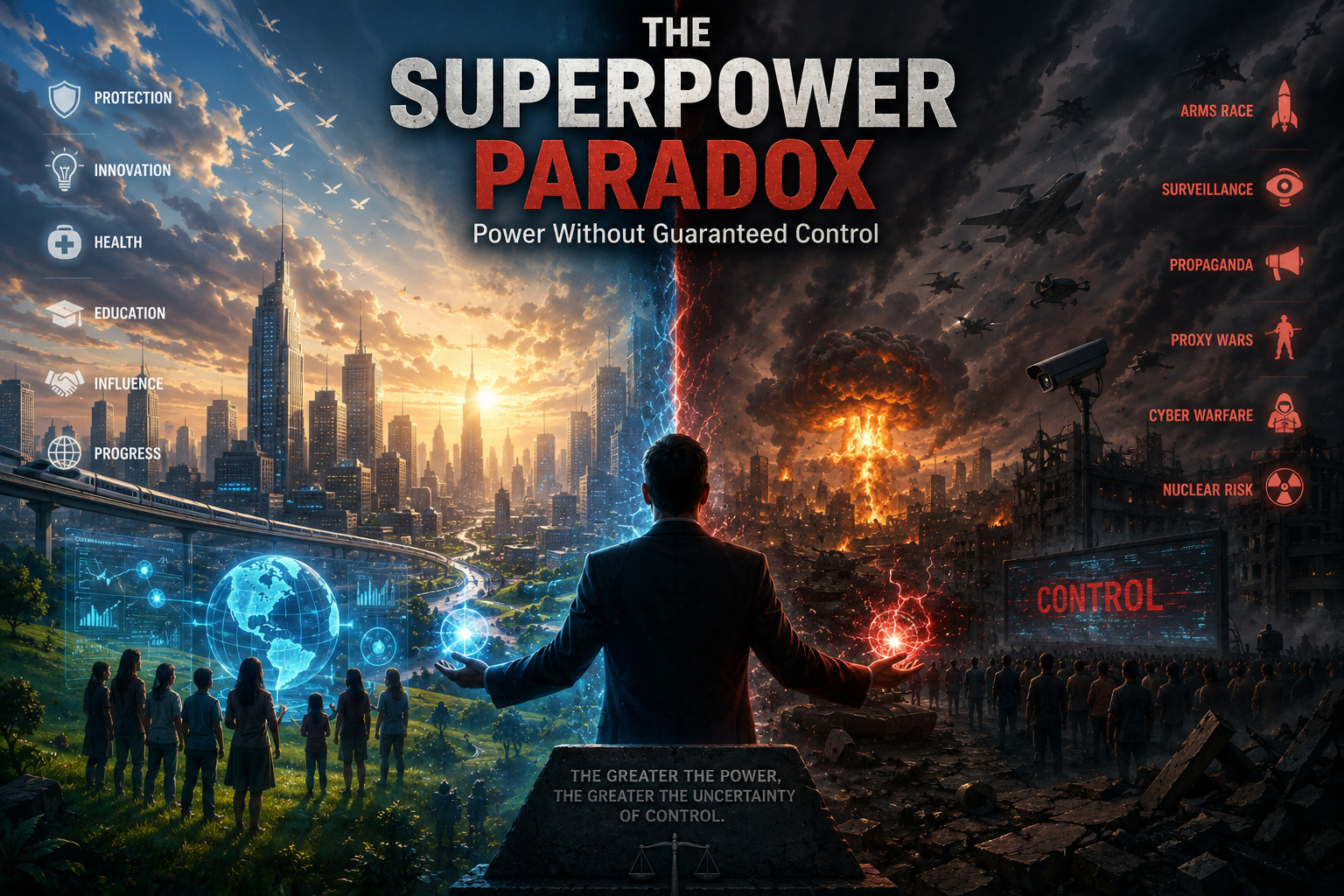
THE SUPERPOWER PARADOX Power Without Guaranteed Control

CHAPTER I
For more than three decades, the United States entered Middle Eastern conflicts from an assumption that became almost synonymous with global power itself: if Washington decided to act militarily, it possessed the capability to dominate the battlefield, dictate the tempo of operations and eventually shape the political outcome.
- That assumption was never absolute.
- Vietnam had already warned otherwise.
Iraq and Afghanistan later demonstrated that overwhelming firepower could destroy armies, governments and military infrastructure without necessarily producing durable political control.
Yet the belief remained powerful.
- The United States possessed the aircraft carriers.
- The United States possessed the stealth bombers.
- The United States possessed the intelligence architecture.
- The United States possessed the satellite networks, precision-guided weapons, logistics chains, air-refuelling capabilities, naval dominance and an extraordinary network of military bases stretching across the Middle East.
Iran possessed none of those advantages on anything approaching the same scale.
On paper, therefore, the contest appeared brutally unequal.
But asymmetrical warfare begins precisely where conventional comparisons end.
- Iran did not need to become America.
- It did not need to build a rival blue-water navy.
- It did not need to match the United States aircraft for aircraft.
- It did not need hundreds of overseas bases.
- It needed something far more limited, and potentially far more attainable:
the ability to survive.
That is the central paradox now confronting American power.
A superpower can possess vastly greater destructive capability than its opponent and still fail to obtain unrestricted strategic control if the weaker opponent remains capable of absorbing punishment, regenerating military capacity, retaliating unpredictably and imposing unacceptable costs over time.
The Iran conflict has therefore become much more than a contest over who possesses the larger military.
It has become a test of whether military supremacy still guarantees political obedience.
That question goes directly to the meaning of power in the twenty-first century.
Winning the Battle Is Not the Same as Ending the War
Modern military power is often measured through visible inventories.
- Aircraft.
- Warships.
- Missile systems.
- Troop numbers.
- Intelligence capabilities.
- Industrial capacity.
By those standards, the United States remains overwhelmingly superior.
But wars are not ultimately decided by equipment lists.
They are decided by political objectives.
The relevant question is not merely whether the United States can strike Iran.
Clearly, it can.
The relevant question is whether repeated strikes can compel Iran to produce the political result Washington seeks.
That is a much harder proposition.
If Washington's objective requires Tehran to surrender strategic independence, abandon core military capabilities, accept externally imposed political conditions or permanently cease retaliatory capacity, then American military success must ultimately produce political compliance.
Iran's objective is potentially much less demanding.
Iran does not necessarily need to defeat the United States militarily.
It may simply need to prevent the United States from achieving decisive political victory.
That distinction changes the entire equation.
If the stronger power must completely suppress resistance while the weaker power needs only to remain operational, then the weaker side possesses a natural advantage in endurance.
One side must succeed repeatedly.
The other side may need only to avoid being permanently defeated.
That is why declarations that an adversary has been "destroyed," "neutralized" or "obliterated" can become strategically dangerous when that adversary soon demonstrates continuing capability.
- Every surviving missile battery becomes a statement.
- Every successful drone launch becomes a statement.
- Every coordinated retaliatory strike becomes a statement.
Every attack launched after an announcement that Iranian military capacity has been eliminated communicates something beyond its immediate military effect:
- Iran is still functioning.
In asymmetric conflict, survival itself becomes strategic communication.
THE DANGER OF CONFUSING DESTRUCTION WITH CONTROL
This may be one of the oldest errors in great-power warfare.
Destroying physical infrastructure is measurable.
Political submission is not.
Bomb damage can be photographed.
Runways can be cratered.
Command centres can be demolished.
Weapons depots can be destroyed.
Military personnel can be killed.
But political will is considerably more difficult to eliminate.
A state may suffer enormous destruction yet refuse capitulation.
- It may decentralize.
- It may conceal assets.
- It may disperse command structures.
- It may rely upon redundancy.
- It may continue fighting with less sophisticated systems.
- It may lower its operational expectations while raising the cost imposed upon its opponent.
This is where conventional military superiority encounters asymmetric reality.
A technologically advanced military often attempts to destroy the enemy's system.
An asymmetric opponent attempts to remain sufficiently functional that no decisive conclusion can be imposed.
Iran has spent decades preparing for that environment.
- Its doctrine developed under sanctions, isolation and the knowledge that it could never compete conventionally with the United States.
- Its strategy therefore evolved around survivability.
- Dispersed missile systems.
- Underground infrastructure.
- Redundant command structures.
- Mobile launch capability.
- Drones.
- Proxy and partner networks.
- Maritime disruption.
- Cyber capability.
- And perhaps most importantly, strategic patience.
None of those individually makes Iran stronger than the United States.
Collectively, however, they can make Iran extraordinarily difficult to neutralize completely.
- And that difference matters.
WHEN THE STRONGER POWER MUST KEEP PROVING IT IS STRONGER
Great powers face a unique psychological burden.
They are expected to dominate.
- A smaller power can absorb losses and still claim success merely because it remains standing.
- A superpower is judged against a much higher expectation.
- If Washington declares that Iranian military capability has been shattered, observers expect Iranian retaliation to diminish dramatically.
- If Iran then produces another major strike, the military significance of that attack may be only one part of its effect.
The larger consequence may be reputational.
- Credibility begins to erode when declared outcomes are repeatedly contradicted by observable events.
That does not mean the underlying military balance has reversed.
- It means perception begins separating from capability.
And deterrence depends heavily upon perception.
- A military can possess enormous destructive force, but if adversaries begin believing that political leaders are reluctant to use it, unable to sustain it, or unable to translate it into decisive strategic outcomes, the deterrent value of that force can weaken.
The problem becomes even more serious when rhetoric repeatedly outruns results.
- Threats matter only when adversaries believe the threatened action is both possible and politically credible.
If overwhelming warnings are followed by hesitation, recalibration, negotiation or partial retreat, different audiences will interpret that behaviour differently.
- Supporters may see restraint.
- Opponents may see caution.
- Adversaries may see vulnerability.
- Allies may see uncertainty.
- And in geopolitical competition, uncertainty itself can reshape behaviour.
IRAN DOES NOT NEED TO WIN AMERICA'S WAR
This is perhaps the most important principle for understanding the present conflict.
Iran does not need to fight according to American definitions of victory.
- It does not need territorial conquest.
- It does not need naval supremacy.
- It does not need air superiority.
- It does not need to destroy the United States military.
- It needs to impose a different strategic reality.
- One where every American escalation carries a cost.
- One where every regional military base requires protection.
- One where every missile interceptor expended creates a replenishment problem.
- One where every prolonged deployment affects readiness elsewhere.
- One where every threat against Hormuz creates economic consequences far beyond the battlefield.
- One where Gulf states increasingly question whether hosting American forces protects them or exposes them.
- One where Washington must calculate Iran's response before deciding the next American move.
That last point is crucial.
- Power is not merely the ability to act.
- Power is also the ability to constrain the choices of others.
If Iran becomes capable of making Washington reconsider where it can strike, how long it can fight, which bases it can safely operate, how many interceptors it can expend and what escalation its allies are willing to tolerate, then Iran has achieved strategic influence without achieving military equality.
- That is asymmetry at its highest level.
THE SUPERPOWER PARADOX
This brings us directly to the central argument.
- The United States may remain the most militarily powerful country involved in the Middle East.
- Iran may remain considerably weaker by almost every conventional measure.
- Yet the weaker power can still force the stronger one into an increasingly defensive calculation.
That is the paradox.
America can destroy more.
- Iran may only need to endure longer.
America can strike farther.
- Iran may only need to keep enough launch capability alive.
America can defend more territory.
- Iran may only need to create enough simultaneous threats that everything cannot be defended equally.
America can replace weapons.
- Iran may only need to force Washington to expend them faster than political patience or industrial production comfortably allows.
America has global commitments.
- Iran is fighting principally inside its own strategic neighbourhood.
Those asymmetries complicate every traditional measurement of military strength.
The result is not that Iran has become militarily stronger than the United States.
It has not.
The result is that the United States may be discovering that superiority does not automatically produce control.
And that distinction may define this entire conflict.
FROM POWER PROJECTION TO POWER EXPOSURE
The next chapter brings that paradox into physical form.
For decades, America's Middle Eastern military bases symbolized dominance.
- They allowed aircraft to deploy rapidly.
- They supported naval operations.
- They housed intelligence assets.
- They supplied troops.
- They reinforced allies.
- They placed American power directly beside potential adversaries.
Iran's asymmetric strategy has begun turning that advantage inside out.
Those bases remain powerful instruments of force projection.
But they have also become fixed coordinates inside Iranian missile range.
- The architecture once designed to place Iran inside an American military perimeter may increasingly place American personnel, aircraft, radar systems, fuel depots, runways and command centres inside Iran's retaliatory perimeter.
That creates one of the most consequential strategic reversals of the entire conflict.
- The United States surrounded Iran with military infrastructure.
- Iran responded by developing the ability to target the infrastructure surrounding it.
- And therefore, Chapter II begins with a question that would have seemed almost unthinkable during the height of uncontested American power:
WHAT HAPPENS WHEN THE BASES BUILT TO DETER THE ENEMY BECOME THE VERY ASSETS THAT MUST BE DEFENDED FROM HIM?
- That is where the story changes.
- That is where power projection becomes exposure.
And that is where Iran's asymmetric strategy begins turning America's Middle Eastern military architecture against itself.
This establishes the intellectual foundation cleanly.
Chapter II — “WHEN THE BASES BECOME THE TARGETS” can now go much deeper into the actual base network, saturation warfare, Patriot/THAAD economics, host-country vulnerability, dispersal, Iraq and the idea of bases shifting from instruments of deterrence toward potential hostages of deterrence.
By: Omar Silva - Editor/Publisher @ www.nationalperspectivebz.com
- Log in to post comments