WALKING BACKWARDS FROM THE ROAD ALREADY WON? The CCJ, Maya Customary Land Rights and Belize's Unfinished Constitutional Promise
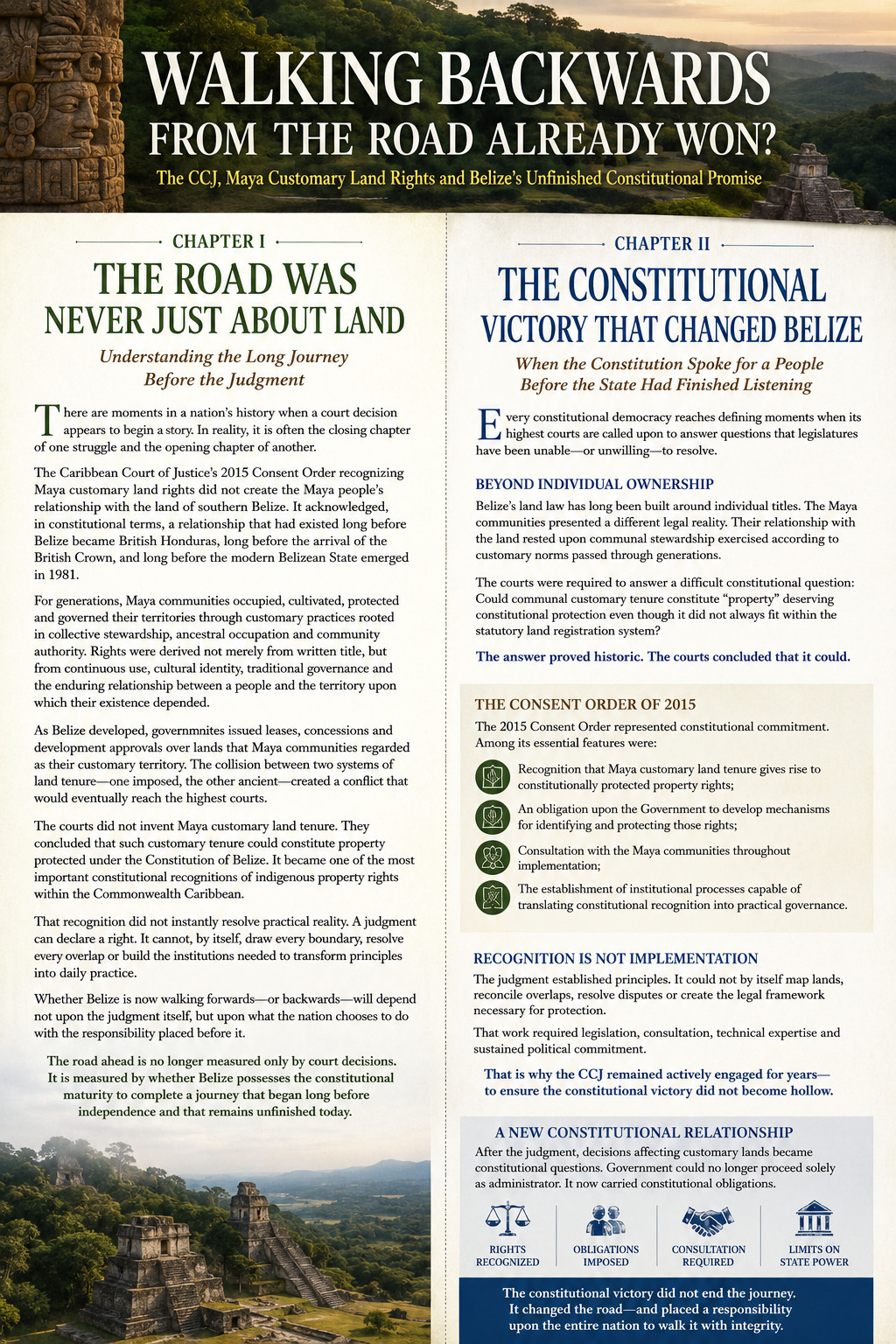
CHAPTER I : THE ROAD WAS NEVER JUST ABOUT LAND
Understanding the Long Journey Before the Judgment
Belize City: Tuesday 4th August 2026: There are moments in a nation's history when a court decision appears to begin a story. In reality, it is often the closing chapter of one struggle and the opening chapter of another.
The Caribbean Court of Justice's 2015 Consent Order recognizing Maya customary land rights did not create the Maya people's relationship with the land of southern Belize. It acknowledged, in constitutional terms, a relationship that had existed long before Belize became British Honduras, long before the arrival of the British Crown, and long before the modern Belizean State emerged in 1981.
That distinction matters.
Too often, public discussion reduces the Maya land-rights question to a legal dispute that began in the courts. It did not. The courts became involved because history, law and public policy had failed to reconcile two fundamentally different understandings of land ownership.
One understanding grew from European legal traditions introduced during the colonial period. It viewed land as something surveyed, registered, titled and administered through statutes enacted by the colonial government and, later, the independent State of Belize.
The other understanding was far older. For generations, Maya communities occupied, cultivated, protected and governed their territories through customary practices rooted in collective stewardship, ancestral occupation and community authority. Rights were derived not merely from written title, but from continuous use, cultural identity, traditional governance and the enduring relationship between a people and the territory upon which their existence depended.
For decades, these two systems existed uneasily beside one another.
As Belize developed, governments issued leases, concessions and development approvals over lands that Maya communities regarded as their customary territory. Forestry, agriculture, protected areas, infrastructure projects and natural resource concessions increasingly intersected with lands occupied and used by Maya villages. In many cases, the State's legal records did not reflect the customary system through which those communities understood their rights.
The result was not simply a legal disagreement over property.
- It became a constitutional question.
- Could a modern democratic State recognize a system of land tenure that had never been comprehensively recorded within its statutory framework?
- Could constitutional protection extend beyond the boundaries of formally registered title?
- Could customary tenure exist alongside Belize's existing land registration system without undermining legal certainty for other landowners and national development?
These questions would eventually reach the highest courts.
- But before judges were asked to answer them, they had already become questions about justice, history and nationhood.
- The litigation that followed was therefore never simply about who owned a particular parcel of land.
It asked something much larger.
What obligations does an independent Belize owe to one of the peoples whose relationship with this territory predates the State itself?
The answers given by the Belize Supreme Court and later affirmed through the Caribbean Court of Justice did not invent Maya customary land tenure. Rather, the courts concluded that such customary tenure could constitute property protected under the Constitution of Belize. The significance of that conclusion cannot be overstated. It represented one of the most important constitutional recognitions of indigenous property rights within the Commonwealth Caribbean.
Yet constitutional recognition did not instantly resolve practical reality.
A judgment can declare a right.
- It cannot, by itself, draw every boundary.
- It cannot identify every customary area.
- It cannot reconcile every overlap between customary occupation, private title, leased Crown lands, conservation zones or public infrastructure.
- Nor can a court, acting alone, build the administrative institutions necessary to transform constitutional principles into functioning public policy.
That work belongs to the State.
- It belongs to legislators who must draft clear laws.
- It belongs to public institutions that must administer those laws fairly.
- It belongs to governments that must consult honestly with affected communities.
- And it belongs to the people of Belize, who must understand that constitutional rights are strengthened—not weakened—when they are implemented transparently, consistently and within the rule of law.
That is precisely why today's developments deserve careful reflection.
The recent decision of the Caribbean Court of Justice has not erased the constitutional recognition achieved through years of litigation. Nor has it withdrawn protection from Maya customary land tenure. Instead, the Court has signaled that the next stage of this journey should now be carried principally by Belize's own constitutional institutions.
Whether that proves to be a step toward legal certainty or a return to uncertainty will depend not upon the judgment itself, but upon what Belize now chooses to do with the responsibility placed before it.
- That is why this publication asks a question rather than makes an accusation.
- Are we walking backwards from the road already won?
The answer cannot be found in headlines alone.
- It will be found in the legislation Parliament enacts, the integrity of the consultation process, the respect shown to constitutional principles, and the willingness of the Belizean State to transform judicial recognition into durable legal reality.
The road ahead is no longer measured only by court decisions.
- It is measured by whether Belize possesses the constitutional maturity to complete a journey that began long before independence and that remains unfinished today.
WALKING BACKWARDS FROM THE ROAD ALREADY WON?
CHAPTER II
The CCJ, Maya Customary Land Rights and Belize's Unfinished Constitutional Promise
THE CONSTITUTIONAL VICTORY THAT CHANGED BELIZE
When the Constitution Spoke for a People Before the State Had Finished Listening
Every constitutional democracy reaches defining moments when its highest courts are called upon to answer questions that legislatures have been unable—or unwilling—to resolve.
For Belize, the recognition of Maya customary land rights became one of those defining moments.
- It was never simply a dispute over land.
- It became a test of whether the Constitution of Belize was broad enough to recognize rights that existed outside the formal system of surveyed parcels, registered titles, and statutory grants inherited from the colonial era.
The litigation challenged a long-standing assumption that only land documented through the machinery of the modern State deserved constitutional protection.
- The courts rejected that assumption.
- Instead, they recognized that property rights protected under the Constitution could arise from customary land tenure where such tenure was historically established, continuously exercised, and formed part of the identity and governance of the communities concerned.
- That principle fundamentally altered Belize's constitutional landscape.
- It demonstrated that constitutional rights do not originate because governments decide to grant them.
- Rather, constitutions exist to recognize, protect and restrain the exercise of governmental power over rights that already exist.
- That distinction lies at the heart of this entire debate.
Beyond Individual Ownership
Much of Belize's land law has historically been constructed around individual ownership.
- Titles are issued to individuals.
- Leases are granted to individuals or companies.
- Mortgages are registered against individual interests.
The legal system therefore became accustomed to viewing property through the lens of individual ownership.
- The Maya communities presented a different legal reality.
- Their relationship with the land was not based solely upon individual possession.
- It rested upon communal stewardship exercised according to customary norms passed through generations.
- The courts were therefore required to answer a difficult constitutional question.
Could communal customary tenure constitute "property" deserving constitutional protection even though it did not always fit neatly within the statutory land registration system?
- The answer proved historic.
- The courts concluded that it could.
- This did not abolish Belize's existing land laws.
- Nor did it invalidate every title or lease previously issued by the Government.
Rather, it required the State to recognize that another legally significant form of land tenure existed and that constitutional protections extended to it.
- That conclusion fundamentally expanded Belize's understanding of property rights under the Constitution.
The Consent Order of 2015
The 2015 Consent Order marked an unusual and important development.
Unlike a traditional judgment in which one side wins and the other loses, the parties agreed to a framework that recognized Maya customary land rights while establishing obligations upon the Government of Belize to implement practical mechanisms capable of protecting those rights.
The Consent Order represented more than legal compromise.
- It represented constitutional commitment.
Among its essential features were:
- recognition that Maya customary land tenure gives rise to constitutionally protected property rights;
- an obligation upon the Government to develop mechanisms for identifying and protecting those rights;
- consultation with the Maya communities throughout implementation;
- and the establishment of institutional processes capable of translating constitutional recognition into practical governance.
The judgment therefore became both constitutional declaration and national roadmap.
The road, however, would prove considerably longer than anticipated.
Recognition Is Not Implementation
One of the greatest misunderstandings surrounding the Maya land rights issue is the belief that the 2015 judgment immediately settled every question.
It did not.
- Recognition is a constitutional act.
- Implementation is an administrative, legislative and political process.
- The Court recognized the right.
But numerous practical questions remained unanswered.
- Where precisely do customary lands begin and end?
- How should competing claims be resolved?
- What happens where private titles overlap with customary occupation?
- How should development projects proceed while demarcation remains incomplete?
- Who speaks for each community?
- How should communal governance interact with existing statutory institutions?
None of these questions could be answered simply by judicial declaration.
- They required legislation, mapping, consultation, technical expertise and sustained political commitment.
This explains why the CCJ remained actively engaged for years after the Consent Order.
The Court understood that constitutional victories can become hollow if governments fail to build the institutions necessary to give them practical effect.
A New Constitutional Relationship
Perhaps the most enduring consequence of the 2015 Consent Order was that it altered the constitutional relationship between the Belizean State and Maya communities.
- Before the litigation, decisions affecting customary lands could too often be approached as ordinary administrative matters.
- After the judgment, those same decisions became constitutional questions.
- Government could no longer proceed solely as administrator.
- It now carried constitutional obligations.
Development approvals, resource concessions, infrastructure planning and land administration affecting customary lands required a legal framework grounded in constitutional recognition, meaningful consultation and respect for rights already affirmed by the courts.
That transformation extended well beyond Maya communities.
- It strengthened the principle that constitutional rights place limits upon governmental discretion.
- No government, regardless of political majority, may simply disregard rights that the Constitution protects.
That principle safeguards every Belizean.
The Meaning of Judicial Courage
Constitutional courts occasionally deliver decisions that reshape a nation's legal landscape.
Such judgments are rarely free from controversy.
- Some welcomed the recognition of Maya customary land rights as a long-overdue affirmation of justice.
- Others feared uncertainty for private landowners, investors and future development.
Those concerns deserved serious consideration.
- But constitutional adjudication is not a popularity contest.
- Courts exist to interpret the Constitution—not to measure public opinion.
In recognizing Maya customary land tenure as constitutionally protected property, the judiciary affirmed that the rule of law must sometimes require governments to reconsider long-established administrative practices where those practices fail to respect constitutional guarantees.
- Whether one agreed with the outcome or not, the judgment demonstrated the independence of constitutional adjudication.
- It reminded Belize that rights are not determined solely by political convenience.
Why the Victory Remains Incomplete
Despite its historic significance, the constitutional victory remains unfinished.
- A constitutional judgment can establish principles.
- It cannot by itself build the legal architecture required for their daily operation.
The institutions responsible for implementation remain national institutions.
- Parliament must legislate.
- Government must administer.
- Communities must participate.
- Courts remain available to resolve disputes.
The constitutional victory therefore created an obligation rather than an endpoint.
- That obligation continues today.
- It explains why the recent CCJ decision should not be misunderstood as closing the chapter on Maya customary land rights.
The Court has simply indicated that the next stage belongs principally to Belize's democratic institutions.
Whether those institutions complete the constitutional promise—or diminish it—remains one of the defining constitutional questions facing Belize.
The Larger Lesson for Belize
The Maya land-rights litigation teaches a lesson extending far beyond southern Belize.
- Constitutions are not merely documents governing elections, ministers or Parliament.
- They exist to protect rights, especially where history has left communities vulnerable or unheard.
- When the courts recognized Maya customary land tenure, they were not creating a privileged class of citizens.
- They were affirming a constitutional principle that should resonate with every Belizean:
The rule of law is strongest when it recognizes justice that history has too often overlooked.
- The challenge before Belize today is no longer whether those rights exist.
- The challenge is whether the nation possesses the legislative wisdom, institutional capacity and political courage to honour them faithfully.
That is the constitutional victory now awaiting completion. Coming in Chapter III
"TEN YEARS UNDER THE EYE OF THE COURT"
The next chapter examines one of the most unusual episodes in Caribbean constitutional history: why the Caribbean Court of Justice remained actively engaged in supervising implementation for nearly a decade, what that supervision accomplished, where it fell short, and why the Court ultimately concluded that Belize itself must now carry the constitutional responsibility forward.
By: Omar Silva - Editor/Publisher @ www.nationalperspectivebz.com
- Log in to post comments