
BELIZE MUST BE ABLE TO HOLD ITS GROUND
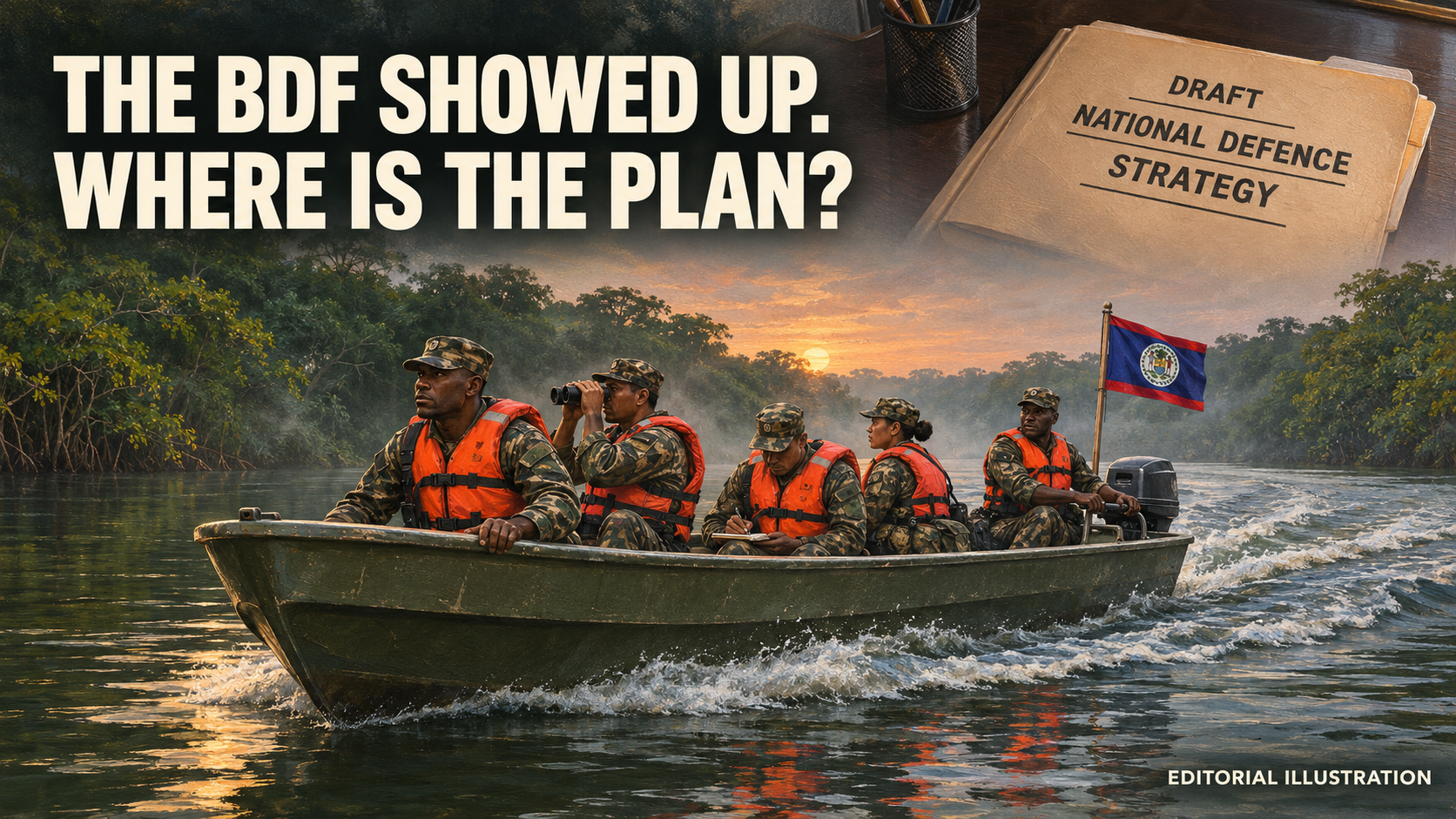
Repeated confrontations on the Sarstoon expose a national defence question. Can Belize give its soldiers the equipment, training and support to keep carrying out lawful missions under pressure?
Sunday Analysis | Belize City 7th November 2026
On October 24, a Belize Defence Force crew took two U.S. Embassy representatives and two technicians upriver to the Cadenas observation post. According to Foreign Affairs CEO Oscar Arnold, one Guatemalan naval vessel tried to obstruct the BDF boat on the way there. Three attempted to intercept it on the way back. The Belizean coxswain maneuvered clear both times. The team completed its assignment and returned safely. The presence of U.S. Embassy personnel aboard did not prevent the encounters. Whether the Guatemalan crews knew who was aboard remains unclear.
- Two weeks later, on November 7, Belize’s Foreign Ministry said two Guatemalan Armed Forces vessels crossed into Belizean waters and aggressively approached a routine BDF patrol near Sarstoon Island. The crew completed its patrol and returned safely. Belize reinforced the forward operating base with BDF and Coast Guard vessels and announced that it would lodge a protest with Guatemala and report the incident to the Organization of American States. The initial statement described an aggressive approach. Whether there was vessel contact remains unverified. As of Saturday evening, public reporting reviewed for this feature had yet to confirm delivery of the protest or a response from Guatemala or the OAS.
There was a civilian encounter before either of those patrols. On September 10, Belize says about 18 Guatemalan military and civilian vessels were present near Sarstoon Island when Belize Territorial Volunteers, escorted by the BDF and Coast Guard, were prevented from completing their customary passage around the island. Belize subsequently announced that it had dispatched a diplomatic note and notified the OAS.
What repeated interference can achieve
- A military can begin to dictate who moves on a river simply by making every passage a confrontation. That is the risk Belize faces while Guatemala’s territorial claim is before the International Court of Justice. Belize maintains that the boundary follows the mid-channel under the 1859 treaty and that Sarstoon Island is Belizean territory. The practical test is whether Belizeans can continue to exercise the rights their government asserts.
- The BDF crew showed discipline. That doctrine must make that discipline sustainable. What does the next crew know about the condition of its boat and communications equipment? How often does it train with the Coast Guard? Can it count on help if there is an injury or a breakdown? Those are questions about morale as much as readiness. Confidence grows when crews know they can report a gap, get it addressed and rely on the people who send them out. Each crew is entitled to know what support it can count on before it leaves the base.
What the budget tells us
Belize approved BZ$69.89 million for its Defence program in 2026–2027. The program includes the BDF and the Joint Intelligence Operation Center. The Coast Guard sits under the separately budgeted Maritime Security program
Defence program, FY 2026–2027 Approved amount
Total program BZ$69,888,893
Recurrent expenditure BZ$69,388,893
Personnel costs, within recurrent expenditure BZ$44,621,393
Dedicated training line BZ$322,109
Arms and ammunition BZ$314,040
Purchase of other equipment BZ$146,626
Capital expenditure, all for buildings and facilities BZ$500,000
Ministry of Finance, Approved Estimates of Revenue and Expenditure 2026–2027, Head 38
Personnel costs account for about 64 cents of every program dollar. The dedicated training line accounts for less than half a cent per dollar and is well below the BZ$858,449 recorded under that line in 2024–2025. The specialized-equipment capital line has a zero allocation for 2026–2027. The recurrent estimates separately provide equipment, fuel, maintenance and spares. The dedicated line captures one part of training expenditure. A full-ready assessment would also account for training financed elsewhere and assistance from partners.
- Paying soldiers is part of defending Belize. So is ensuring that the skills, equipment and support they depend on are available every time they deploy. The budget tells Parliament what was appropriated. Parliament should be able to ask what improvement in readiness those appropriations will buy.
How a small force earns credibility
An asymmetric defence architecture starts with a clear purpose. Belize must be able to detect interference early, carry on with lawful operations under pressure, and preserve a reliable account that its government can act on. A small force gains credibility when it can do those things consistently across crews, rotations and incidents.
- Build a common picture. Connect the BDF, its Air Wing, the Coast Guard and civilian authorities so they can share verified information. Set a common standard for incident records and evidence so an encounter can be reconstructed and acted on promptly.
- Fund the whole capability. A patrol vessel requires a trained crew, communications, maintenance, fuel, spare parts and medical support. Budget for those together. Apply the same discipline to aircraft, vehicles and heavier land capabilities by testing each proposed investment against a defined mission and its cost over time.
- Train and assess the services together. Make joint riverine and land training, casualty evacuation and decision-making under pressure recurring commitments. Give personnel a way to report equipment and training gaps and track whether they are fixed.
- Carry the response through to diplomacy. Assign responsibility for verifying incidents, delivering protests and reporting back to the public. In June, both countries asked the OAS to assist with incident verification within its existing mandate. In September, Secretary General Albert Ramdin described limits on the Adjacency Zone office’s authority over river incidents. Belmopan should say what action it is seeking from the OAS and report when it gets a response. The decision belongs to Cabinet
The Office of the Chief of Staff for Defence reported that it had completed a draft National Defence Strategy. Has Cabinet adopted it? Which capabilities will Belize fund first? Who will deliver them, on what timetable, and how will Parliament know whether readiness has improved? A public summary can answer those questions while protecting patrol schedules, deployment details and sensitive inventories.
- The Cadenas crew found its way through. The November 7 crew finished its patrol. Cabinet’s responsibility is to make sure the next crew can count on a system built to support it, from the moment it launches to the moment Belmopan accounts for what happened.
By: Omar Silva -Editorial Director/Publisher @ www.nationalperspectivebz.com
National Perspective Belize – Digital | ©
- Log in to post comments
