THE QUESTION BEL STILL HAS NOT FULLY ANSWERED: THE COST OF POWER IS ONE ISSUE. WHAT THE METER SAYS YOU CONSUMED IS ANOTHER.
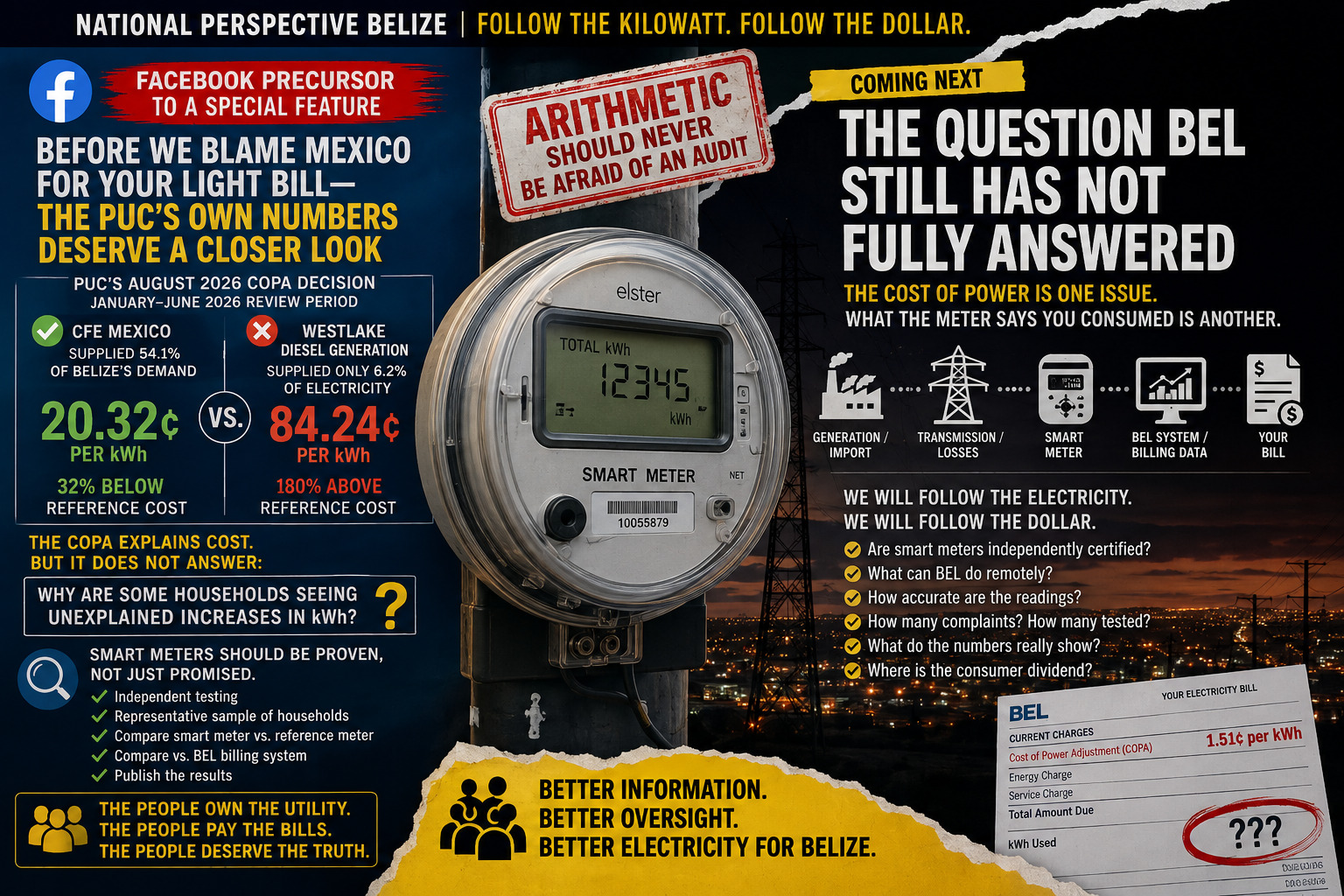

Follow up to my Facebook Post earlier: BEFORE WE BLAME MEXICO FOR YOUR LIGHT BILL — THE PUC'S OWN NUMBERS DESERVE A CLOSER
***Consumer & Energy Analysis
Belize City: Saturday 22nd August 2026: There is useful information in Horace Palacio's argument about Belize's electricity problem. But there is also a danger in accepting the conclusion that there is "no villain, just arithmetic" before asking whether all of the arithmetic itself has been independently examined.
Because Belizeans are dealing with two separate electricity questions, and they should not be confused.
- The first concerns the price of producing and purchasing electricity.
- The second concerns the quantity of electricity that BEL says an individual household consumed.
- The Cost of Power Adjustment addresses the first.
- It does not, by itself, settle the second.
- And that distinction may be the missing centre of the present national conversation.
FIRST, LET US ACCEPT WHAT THE OFFICIAL NUMBERS ACTUALLY SHOW
The PUC's August 2026 decision establishes that BEL's average Cost of Power during the January-June review period exceeded the approved Reference Cost of Power by approximately 4.33 cents per kilowatt-hour.
Because the regulatory mechanism limits the immediate adjustment, the PUC authorized BEL to collect 1.51 cents per kWh during August, except from Social Rate customers.
That is real.
But something else in the PUC decision deserves attention.
- During those six months, CFE Mexico was actually BEL's largest and relatively inexpensive supplier, providing 54.1% of electricity demanded at an average BZ$0.2032/kWh—32% below the approved reference cost.
- The extraordinary cost was BEL's Westlake diesel generation: only about 6.2% of energy supplied, but at an average BZ$0.8424/kWh—approximately 180% above the reference cost. The PUC specifically identified Westlake as contributing significantly to the cost overrun.
That makes the situation considerably more nuanced than simply saying:
- "Half our electricity comes expensively from Mexico."
- For the January-June 2026 COPA period, the regulator's own numbers show that Mexican electricity was comparatively cheap; expensive diesel generation was a major contributor to the overrun.
That distinction matters.
BUT THAT STILL DOES NOT ANSWER THE HOUSEHOLDER'S QUESTION
- Imagine a Belizean household that previously consumed 150 kWh.
- Then its bill suddenly says 230 kWh.
- Explaining why each kilowatt-hour costs more does not explain why the meter says the family used 80 additional kilowatt-hours.
Those are two completely different calculations:
CONSUMPTION × TARIFF = ELECTRICITY CHARGE
BEL and the PUC can explain the tariff.
- But if consumers are questioning the consumption figure itself, then telling them about CFE, diesel generation, climate change or COPA does not fully answer their complaint.
That is precisely where Belize needs a deeper investigation.
ENTER THE SMART METER
BEL has embarked upon a major transformation of the country's electricity metering system.
And this is not merely replacing an old mechanical meter with a prettier digital meter.
BEL's own documentation describes Advanced Metering Infrastructure as a system capable of two-way communication between the utility and the customer's meter, providing near-real-time information and greater operational control. BEL's 2024 tariff submission said the technology could support automated meter reading, revenue protection, time-of-use tariffs, prepaid metering, outage management, demand response, voltage monitoring and other functions.
- The nationwide programme involves approximately 115,000 smart meters, supported by communications and analytics infrastructure, financed through a US$27.53 million CDB loan-and-grant package announced in December 2025.
That technology can provide enormous benefits.
But precisely because it is considerably more sophisticated than the meter it replaces, public confidence requires something more substantial than:
"Trust us. The meter is accurate."
CAN BEL SIMPLY "MANIPULATE" A SMART METER?
This is where we must be responsible.
- There is presently no evidence before us establishing that BEL is deliberately manipulating customers' meter readings, and National Perspective should not make that allegation without evidence.
But the absence of evidence of manipulation is not the same thing as saying that independent verification is unnecessary.
- Smart meters involve metrology, firmware, communications systems, configuration settings, databases and billing software.
Therefore, legitimate technical questions exist:
- Are the meters independently certified?
- What accuracy standard applies?
- Who verifies calibration before installation?
- Are old and new meters ever run side-by-side during validation?
- Can meter configuration be altered remotely?
- What functions can BEL execute remotely?
- Are those actions permanently logged?
- Who has administrative access?
- Can historical readings be altered inside the billing system?
- What cybersecurity controls exist?
- How are meter readings transferred into the billing database?
- What happens when communications fail?
- How are estimated readings distinguished from actual readings?
- How many smart meters have been challenged?
- How many have subsequently been tested?
- How many failed testing?
- What percentage of customers experienced material consumption increases following meter replacement?
- Those questions do not accuse BEL of wrongdoing.
- They are the questions that a sophisticated regulatory system should already be capable of answering.
AND HERE IS WHY THE PUBLIC'S CONCERN CANNOT SIMPLY BE DISMISSED
Reports questioning unusually high electricity bills did not begin with the August COPA.
Customers were publicly complaining about unusually high bills months earlier. In May 2026, reports described consumers saying their bills had nearly doubled despite what they believed was normal usage.
By June, the issue had become sufficiently significant that the PUC itself advised consumers to monitor their meters and compare those readings with their bills. The Commission advised customers to act where they observed sudden increases, consumption inconsistent with household activity, or significant discrepancies between meter readings and billing information.
- BEL's explanation has largely been that hotter temperatures cause refrigerators, fans and air conditioners to work harder. Executive Chairman Lynn Young said BEL investigated complaints and that increased consumption associated with heat explained almost all of them.
There is certainly scientific logic behind that explanation.
- A refrigerator operating in a hotter room must generally work harder.
- Air conditioners obviously consume more energy during extreme heat.
But that cannot become a universal explanation applied to every household without examining the individual evidence.
- Because what about the pensioner without air-conditioning?
- What about the small wooden home with two fans, several LED bulbs and one modest refrigerator?
- What about households reporting dramatic increases rather than marginal seasonal changes?
Those consumers deserve something better than a general explanation about May being hot.
- They deserve measurement.
BEL SHOULD WELCOME AN INDEPENDENT SMART-METER AUDIT
This is where the debate should now go.
Instead of arguing indefinitely over whether consumers or BEL are correct, establish the answer scientifically.
- The PUC should commission—or supervise—an independent national smart-meter verification programme.
Take a statistically representative sample of households across Belize.
- Include customers reporting abnormal increases and customers reporting no problems.
- Install a certified independent reference meter alongside BEL's smart meter for 60 or 90 days.
- Measure precisely the same electricity flowing into the property.
Compare:
- BEL SMART METER
versus
- INDEPENDENT REFERENCE METER
versus
- BEL BILLING DATABASE
Then publish the anonymized results.
- If the smart meters prove accurate, BEL's position becomes immeasurably stronger.
- If discrepancies appear, Belize discovers a problem that needs correcting.
Either way, the country gets evidence instead of arguments.
THERE IS ALREADY A MECHANISM FOR METER TESTING
BEL's own published schedule lists a "Meter Change for Testing" charge of BZ$18.
That raises another question:
Why should this remain primarily an individual consumer-by-consumer dispute if substantial numbers of people are raising essentially the same concern?
- If hundreds or thousands of Belizeans believe something changed after the introduction of smart meters, the appropriate response is not hundreds of isolated arguments at BEL's customer-service counter.
It is a systemic regulatory investigation.
BELIZEANS HAVE ALSO FINANCED THE MODERNIZATION OF THIS UTILITY
There is another part of this history that should not disappear.
Government assumed control of BEL in June 2011. Historical BEL financial statements themselves record Government-related financing and earlier Government/IBRD on-lending arrangements.
More recently, Government completed the acquisition of Fortis' remaining Belize electricity interests in October 2025: BZ$224 million for the hydroelectric assets now under Hydro Belize Limited and BZ$36 million for Fortis' 33.3% BEL stake, bringing Government ownership of BEL to 65.9%. The Central Bank says one policy objective was "electricity cost stabilisation", including removal of legacy contractual price escalators.
And now another US$27.2 million CDB loan is helping finance BEL's smart meter/grid modernization programme.
Therefore, Belizeans are entitled to ask a very simple long-term question:
WHERE IS THE CONSUMER DIVIDEND?
Not necessarily electricity that becomes cheaper every single year—energy economics does not work that simply.
But after nationalization, hydro acquisition, repeated infrastructure financing, modernization, improved technology and public ownership, when does greater national control translate into demonstrably better affordability for the ordinary Belizean household?
That is a legitimate public-policy question.
AND THIS IS WHERE "NO VILLAIN, JUST ARITHMETIC" BECOMES TOO SIMPLE
There may indeed be no villain.
But there are institutions with responsibilities.
- BEL has a responsibility.
- The PUC has a responsibility.
- Government, as majority owner and policymaker, has a responsibility.
And consumers have responsibilities too.
- If somebody leaves an air conditioner running twelve hours a day, that consumption cannot reasonably be blamed upon BEL.
But accountability works in both directions.
A poor household cannot continually be told:
- Use less electricity.
At some point we must ask:
How much less can a household with one refrigerator, two fans and three LED bulbs reasonably use?
Electricity in a modern society is not a luxury.
- It preserves food.
- It provides light for children to study.
- It operates communications.
- It powers small businesses.
- It makes homes tolerable in a tropical climate.
There is a floor beneath which "conservation" simply becomes energy poverty.
THE QUESTION BELIZE SHOULD NOW PUT TO BEL AND THE PUC
- We therefore should not accuse BEL of manipulating meters.
- We should demand something much stronger than an accusation:
PROVE THE SYSTEM.
- Publish the smart-meter technical standards.
- Publish the certification and calibration procedures.
- Disclose failure and replacement rates.
- Explain precisely what BEL can and cannot do remotely.
- Publish the cybersecurity and audit safeguards that can safely be disclosed.
- Provide anonymized before-and-after consumption statistics for customers converted from conventional to smart meters.
- Establish independent meter testing.
- Audit the interface between meters and the billing system.
- And allow the regulator—not BEL alone—to determine whether the widespread complaints have statistical merit.
- Because if BEL is correct, independent testing will vindicate BEL.
- And if consumers are correct, independent testing will expose the problem.
Either outcome is preferable to asking struggling Belizeans simply to believe one side.
THE REAL EQUATION
The national electricity debate is therefore bigger than COPA.
It is:
**GENERATION COST
- IMPORT DEPENDENCE
- GRID EFFICIENCY
- METER ACCURACY
- BILLING INTEGRITY
- REGULATORY OVERSIGHT
- HOUSEHOLD AFFORDABILITY
= THE TRUE COST OF ELECTRICITY TO BELIZE**
One important thing:
- Arithmetic matters.
- But arithmetic should never be afraid of an audit.
- And before Belize tells a working mother that her refrigerator suddenly consumed dramatically more electricity because May was hot, we should be prepared to prove it with the very technology that BEL says can measure electricity almost in real time.
That is not hostility toward BEL.
That is what public ownership should mean.
- The people own the utility.
- The people are financing its modernization.
- The people pay the bills.
And therefore, the people have every right to demand that when something on those bills suddenly changes, the answer must be more than:
"THE METER SAYS SO."
It should be:
"HERE IS THE INDEPENDENT EVIDENCE THAT PROVES IT."
By: Omar Silva – Editorial Director @ www.nationalperspectivebz.com
- Log in to post comments