IF RED FLAGS WERE MISSED, WHO WAS WATCHING?
EDITORIAL
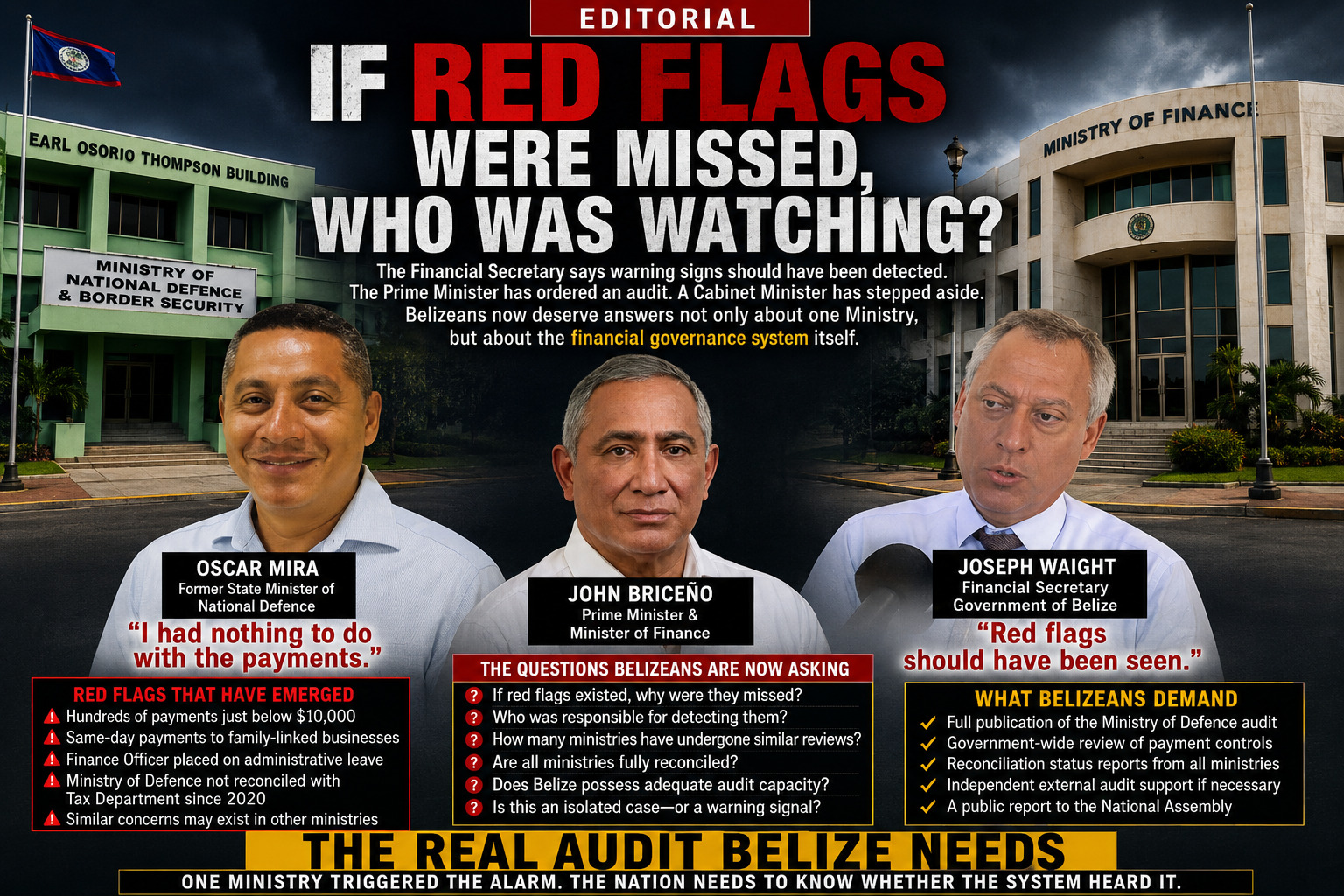
Belize City: Thursday 25th June 2026: The Financial Secretary says warning signs should have been detected. The Prime Minister has ordered an audit. A Cabinet Minister has stepped aside. Belizeans now deserve answers not only about one Ministry, but about the financial governance system itself.
The Ministry of Defence may have triggered the alarm. The nation now deserves to know whether the warning applies to the wider system of government.
For weeks, the public debate has centered on Oscar Mira, procurement contracts, SmartStream records, and payment patterns that have generated widespread concern.
But after listening carefully to the Financial Secretary, the Prime Minister, the National Trade Union Congress of Belize, and the growing chorus of public concern, it has become increasingly apparent that the conversation has evolved beyond one Minister and one Ministry.
The issue now confronting Belize is much larger.
It is the question of financial governance.
The Financial Secretary, Joseph Waight, has publicly acknowledged that the payment patterns uncovered thus far appear suspicious and that red flags should have been detected. He has further suggested that other ministries may wish to examine their own systems and controls to determine whether similar vulnerabilities exist elsewhere.
Those statements are significant.
- They do not come from political opponents.
- They do not come from social media commentators.
- They do not come from trade unions.
They come from the Government's own chief financial administrator.
Belizeans should pay attention.
Because when the nation's Financial Secretary publicly admits that warning signs should have been seen, a new question emerges:
- If the red flags should have been seen, why were they not?
The Ministry of Defence may be where the spotlight first landed, but government ministries do not operate in isolation.
Every ministry functions within a framework of financial controls, accounting procedures, reporting structures, procurement regulations, budget allocations, reconciliation requirements, and oversight responsibilities.
That framework ultimately falls under the wider authority of the Ministry of Finance.
This is why the issue can no longer be confined to a discussion about one supplier, one contract, one Finance Officer, or even one Minister.
Belizeans are now entitled to ask whether the safeguards designed to protect public funds are functioning as intended.
The Prime Minister, acting in his capacity as Minister of Finance, has ordered an audit.
That was the correct first step.
But an audit alone cannot restore public confidence.
- Confidence is restored through transparency.
- Confidence is restored through facts.
- Confidence is restored when findings are made public and corrective action follows where necessary.
The placement of a Finance Officer on administrative leave is not proof of wrongdoing.
Neither is the stepping aside of a Cabinet Minister proof of guilt.
However, both actions acknowledge that serious questions now exist and that those questions require answers.
The public deserves those answers.
- The public also deserves to know whether the circumstances now under review are isolated to a single ministry or whether they reveal broader weaknesses in the administration of public finances.
That question cannot be dismissed as political.
- It is a legitimate governance question.
- The Financial Secretary himself has suggested that ministries should review their own systems.
- The NTUCB has called for broader scrutiny.
- Members of the public are asking whether financial controls are operating effectively across government.
These are reasonable concerns.
- The Belizean people should not fear an audit.
- Honest public officers should not fear an audit.
- Honest ministers should not fear an audit.
- Honest governments should not fear an audit.
Audits do not weaken institutions.
- They strengthen them.
- They either confirm that systems are working or identify where improvements are required.
In either case, the public benefits.
This is why Belize should not stop at the Ministry of Defence.
The Government should consider a comprehensive review of reconciliation practices, payment controls, procurement compliance, and financial oversight mechanisms across the public service since 2020.
- Not because wrongdoing has been established elsewhere.
- Not because every ministry is suspect.
- But because public confidence must be built on verification rather than assumption.
At the heart of this controversy lies a simple principle:
- Public money belongs to the people of Belize.
- Every dollar collected through taxation, customs duties, licenses, fees, and public borrowing must be subject to proper stewardship and accountability.
- The Belizean people have a right to know that the systems designed to protect those funds are functioning effectively.
- The Ministry of Defence may have triggered the alarm.
The Government of Belize must now demonstrate whether the alarm revealed an isolated problem or exposed a wider weakness within the machinery of financial governance itself.
- The time for reassurance has passed.
- The time for verification has arrived.
And the Belizean people deserve nothing less than the full truth.
By: Omar Silva - Editor/Publisher
NATIONAL PERSPECTIVE BELIZE
- Log in to post comments