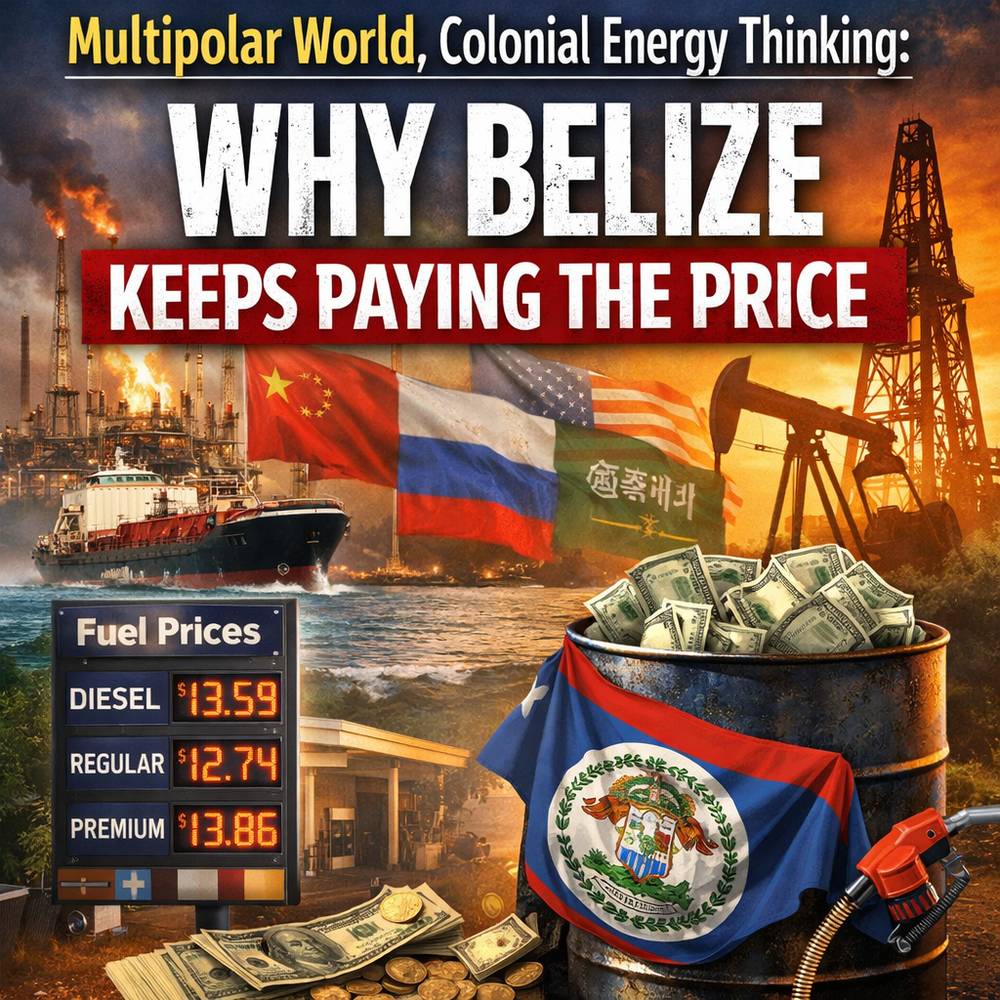
**MULTIPOLAR OIL MARKETS: The Global Power Shift Belize Cannot Afford to Ignore**
By: Omar Silva I Editor/Publisher
National Perspective Belize Digital 2026
www.nationalperspectivebz.com
Belize City: Sunday 29th March 2026
📰 SUNDAY HEADLINEFEATURE
🌍 A World No Longer Controlled by One Energy Power
For decades, the global oil market moved to a predictable rhythm—set largely by Western powers, priced in U.S. dollars, and enforced through political alliances and economic pressure.
That world is gone.
Today, oil no longer answers to a single authority. It flows through a fragmented, competitive, and politically diverse system where multiple global players—often with conflicting interests—shape supply, pricing, and access.
This is what experts now call a multipolar oil market.
But for Belize, this is not an abstract geopolitical concept.
It is the invisible force driving the rising cost of living, the volatility at the pump, and the growing pressure on every household and business across the country.
⚖️ From One Power Centre to Many
There was a time when:
- Oil was traded almost exclusively in U.S. dollars
- Western-aligned producers dominated supply chains
- Sanctions could shut down entire oil economies overnight
Now:
- Russia sells oil to India and China outside Western systems
- Saudi Arabia negotiates energy deals beyond traditional alliances
- China secures long-term supply agreements in its own currency
- Iran exports through alternative networks despite sanctions
The market has fractured—not collapsed—but reorganized into competing centres of power.
And in that reorganization, control has shifted.
🔑 The Forces Driving This Transformation
1. Geopolitical Realignment
Global conflicts and shifting alliances have forced countries to rethink dependency. Energy is no longer just economic—it is strategic.
2. Currency Diversification
Oil is no longer exclusively tied to the U.S. dollar. Transactions now occur in yuan, rupees, and bilateral exchange arrangements, weakening traditional financial dominance.
3. Sanctions Resistance
Sanctioned nations have adapted. New shipping routes, insurance mechanisms, and payment systems allow oil to move outside Western oversight.
4. Strategic Self-Interest
Countries are no longer guided by ideology. The question is no longer “Who are our allies?” but “Who can supply us consistently and affordably?”
⛽ The Result: A Market That Is Both Flexible and Unstable
Multipolarity creates opportunity for major players—but instability for everyone else.
Prices respond rapidly to conflicts across multiple regions
Supply chains stretch across longer, more complex routes
No single entity stabilizes the market
The outcome is a system defined by uncertainty and sudden shocks.
🇧🇿 Belize: Caught in the Crosswinds
This is where the global meets the local—brutally.
Belize does not produce oil at scale. It does not refine. It does not control shipping routes. It does not negotiate large bilateral energy deals.
Yet Belize absorbs every external shock.
⚠️ 1. Price Spikes with No Warning
The recent surge in fuel prices is not an isolated event—it is the direct consequence of global multipolar dynamics.
A conflict in Eastern Europe.
A shipping disruption in the Middle East.
A surge in Asian demand.
All of it lands—quietly but forcefully—on the Belizean consumer.
⚠️ 2. The Tax Multiplier Effect
As you have consistently highlighted in your reporting:
Belize does not just import fuel—it imports volatility and then taxes it.
When global prices rise:
Government tax structures remain fixed or increase
The final price paid by Belizeans becomes disproportionately high
This is not just economics. It is policy layered on vulnerability.
⚠️ 3. Supply Chain Exposure
In a multipolar world:
Supply routes are longer
Disruptions are more frequent
External actors (including non-state players) can influence flow
Recent border disruptions and logistical uncertainties are not isolated—they are part of a broader pattern of fragile supply systems.
⚠️ 4. Strategic Absence
While major economies:
Lock in long-term supply contracts
Diversify energy sources
Invest in storage and refining capacity
Belize remains:
Reactive
Dependent
Structurally exposed
🧠 The Hard Truth Belize Must Confront
Multipolar oil markets are not the problem.
- They are the reality.
- The real issue is this:
Belize is navigating a 21st-century global energy system with a 20th-century policy mindset.
🔍 What Must Change
If Belize is to survive—and eventually thrive—in this new energy order, several strategic shifts must be considered:
✔ Diversification of Supply Sources
Not reliance on a single import channel, but multiple negotiated pathways
✔ Regional Energy Partnerships
Engagement with Mexico, Central America, and the Caribbean for cooperative energy strategies
✔ Investment in Storage & Buffer Systems
Strategic reserves to absorb short-term shocks and stabilize domestic pricing
✔ Renewable Transition With Realistic Timelines
Reducing dependency without illusion—balancing renewables with transitional energy security
✔ Tax Policy Reform
Re-evaluating how fuel is taxed in a volatile global environment
🔥 Final Word: A World That Has Moved On
The global oil market has already changed.
- It no longer waits for permission.
- It no longer follows a single command.
- It no longer guarantees stability.
It is multipolar, competitive, and unpredictable.
⚠️ And Belize?
Belize now stands at a crossroads:
Continue reacting to global shocks—
or begin preparing for them.
Because in a multipolar oil world:
Those who do not plan… pay.
And those who do not adapt… fall behind.
- Log in to post comments