THE PRODUCTIVITY MYTH: Why Belize Must Stop Mistaking Consumption for Development
Belize City: Friday 12th June 2026: Every few months Belizeans are presented with another encouraging report.
- Economic growth is up.
- Tourism arrivals are increasing.
- Foreign investment is expanding.
- The banking sector is performing well.
- International agencies praise macroeconomic stability.
Government officials speak of resilience.
Banks speak of opportunity.
- Development institutions speak of modernization.
Yet many Belizeans continue to ask a simple question:
If the economy is doing so well, why does it feel like ordinary people are working harder just to stay in the same place?
This question deserves an honest answer.
- Not a political answer.
- Not a partisan answer.
- Not a banker’s answer.
- Not a government answer.
An economic answer.
The First Truth: Belize Produces Too Little of What It Consumes
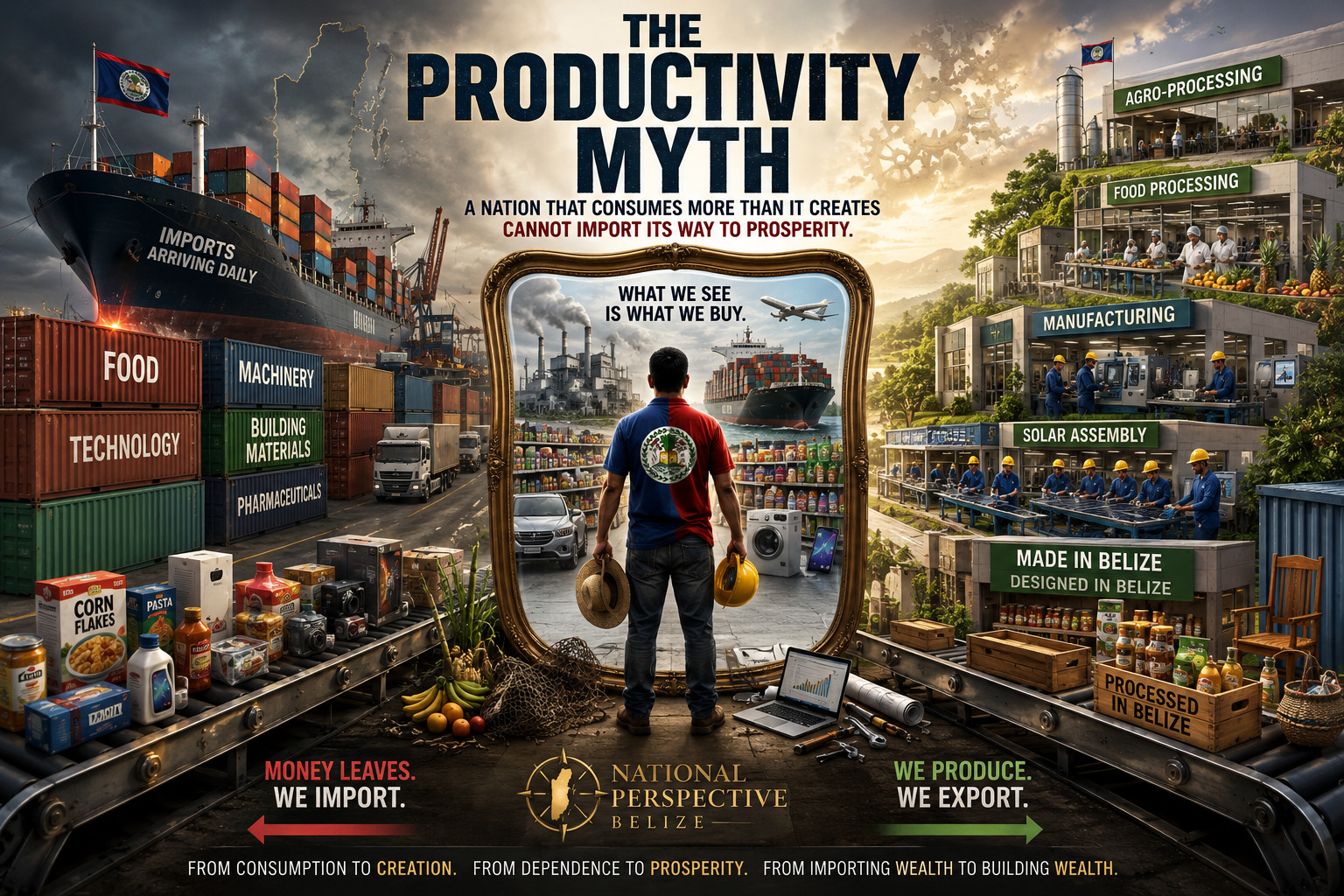
The modern Belizean economy is fundamentally dependent on imports.
Walk into almost any supermarket.
The shelves reveal the reality.
- Imported cereals.
- Imported canned foods.
- Imported beverages.
- Imported cleaning products.
- Imported pharmaceuticals.
- Imported electronics.
- Imported machinery.
- Imported construction materials.
- Imported household goods.
- Imported vehicles.
- Imported technology.
Even products that could be produced locally often arrive from overseas.
This creates a dangerous contradiction.
Belize earns foreign exchange through tourism, agriculture, and a few exports, but spends vast amounts of that foreign exchange purchasing goods produced elsewhere.
In practical terms, wealth continually leaves the country.
Every imported product represents employment, manufacturing activity, and profits generated somewhere else.
The Second Truth: We Export Raw Products and Import Finished Products
This pattern has existed since colonial times.
Belize exports:
- Sugar
- Bananas
- Citrus
- Seafood
- Agricultural commodities
Meanwhile Belize imports:
- Processed foods
- Manufactured products
- Technology
- Industrial equipment
The greatest profits are often made not from growing raw products but from processing, manufacturing, branding, and distributing them.
Those higher-value stages frequently occur outside Belize.
The result is that Belize participates in the lowest-value segment of many supply chains while purchasing back higher-value finished goods.
The nation works hard but captures only a fraction of the total value.
The Third Truth: Tourism Alone Cannot Build a Sovereign Economy
Tourism remains one of Belize's most important industries.
- It provides employment.
- It generates foreign exchange.
- It supports thousands of families.
But tourism is not manufacturing.
- Tourism is not industrialization.
- Tourism does not create the same productive ecosystem created by factories, technology industries, logistics hubs, and advanced processing sectors.
A tourism-dependent economy remains vulnerable to:
- Global recessions
- Pandemics
- Hurricanes
- Fuel prices
- International travel trends
Belize learned this lesson during COVID-19.
An economy cannot be considered fully secure when one external shock can suddenly halt a major source of income.
The Fourth Truth: GDP Growth Does Not Automatically Mean Prosperity
Government officials often point to GDP growth as evidence of success.
Growth matters.
But growth alone does not tell the full story.
A country can experience GDP growth while:
- Food prices rise.
- Housing becomes less affordable.
- Wages stagnate.
- Young professionals emigrate.
- Small businesses struggle.
- Public debt expands.
The average citizen experiences reality through purchasing power, opportunity, and quality of life—not through economic statistics.
The economy should ultimately serve the people.
The people should not be expected to celebrate statistics that do not improve their daily lives.
The Fifth Truth: Productivity Is Not About Working Harder
Belizeans already work hard.
- Farmers work hard.
- Fishermen work hard.
- Construction workers work hard.
- Tourism workers work hard.
- Entrepreneurs work hard.
Productivity is not primarily about effort.
It is about systems.
A nation becomes more productive when it can create more value from its resources.
The question is not:
"How hard are Belizeans working?"
The question is:
"What are Belizeans producing?"
And perhaps more importantly:
"What are Belizeans not producing that they should be producing?"
The Sixth Truth: The Banking Sector Profits from Economic Activity—Not Necessarily Economic Transformation
Banks perform an important function.
- They facilitate commerce.
- They provide credit.
- They support investment.
But banks are not development strategies.
A banking sector can report healthy profits while the broader productive economy remains weak.
A growing loan portfolio does not automatically mean growing national productive capacity.
- Consumption can generate bank profits.
- Imports can generate bank profits.
- Debt can generate bank profits.
None of these necessarily create lasting national wealth.
The critical question is whether credit is financing production or merely financing consumption.
The Seventh Truth: Belize Has Never Fully Completed Economic Independence
Political independence was achieved in 1981.
Economic independence remains unfinished.
- A nation that imports most of what it consumes remains vulnerable to decisions made elsewhere.
- A nation that depends heavily on foreign capital remains vulnerable to external conditions.
- A nation that exports primarily raw materials remains vulnerable to international price fluctuations.
True economic sovereignty requires productive capacity.
- The ability to feed oneself.
- The ability to manufacture.
- The ability to innovate.
- The ability to process local resources into higher-value products.
The Question Belize Must Ask
For more than forty years, Belize has debated politics.
Perhaps it is time to debate production.
Not who governs.
But what is being built.
Not who receives appointments.
But what industries are being created.
Not how much money is being borrowed.
But how much wealth is being produced.
The defining question of the next generation may not be whether Belize grows.
The defining question may be whether Belize finally becomes a nation that creates more than it consumes.
Because no country has ever borrowed its way to prosperity.
No country has imported its way to sovereignty.
And no country has achieved lasting development by confusing consumption with production.
Belize's future will ultimately depend on one thing:
- Not how much we spend.
- Not how much we borrow.
- Not how much we import.
But how much we produce.
By: Omar Silva – Editor/Publisher
National Perspective Belize – Digital
- Log in to post comments