TWO GOVERNMENT BANKS, ONE TAXPAYER: Why Is Belize Creating a Development Bank While Already Owning a National Bank?
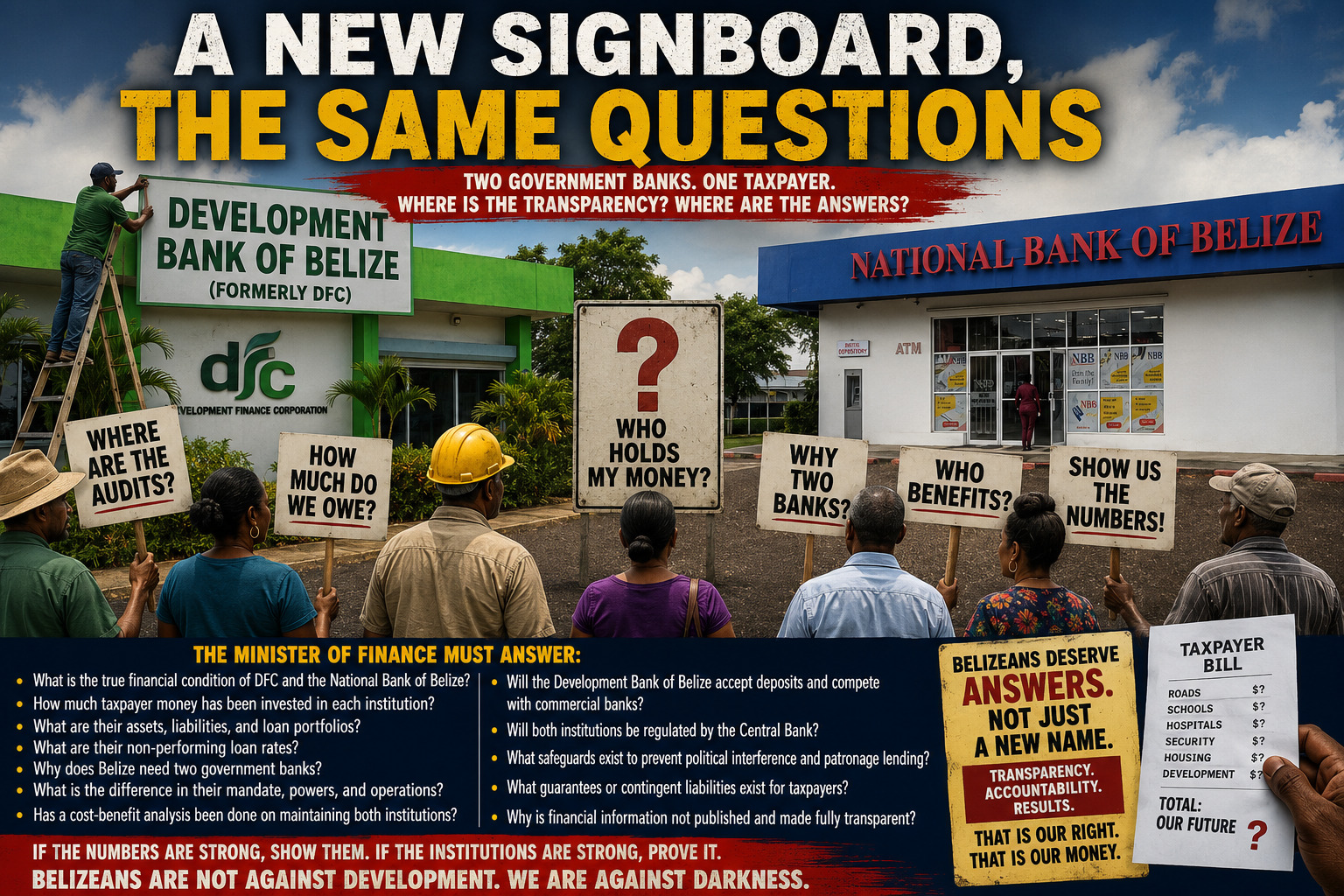
Belize City: Friday 5th June 2026: On June 4, 2026, Prime Minister and Minister of Finance John Briceño rose in the House of Representatives to introduce what many initially viewed as a simple administrative measure: an amendment to rename the Development Finance Corporation (DFC) as the Development Bank of Belize.
According to the Prime Minister, the move is intended to better reflect the institution's present role and align its identity with other development banking institutions throughout the Caribbean.
On the surface, the explanation appears straightforward.
Yet beneath that seemingly harmless amendment lies a series of profound questions that every Belizean taxpayer should be asking.
Questions that have little to do with a name change and everything to do with transparency, governance, public finance, accountability, and the future direction of Belize's financial institutions.
The first question is perhaps the simplest:
Why does Belize need two government-owned banks?
A TALE OF TWO PUBLIC FINANCIAL INSTITUTIONS
Belize already possesses a state-owned banking institution.
The Belize National Bank was established by legislation under a previous administration and was presented as a vehicle to expand access to affordable banking services while increasing competition within the domestic banking sector.
It was funded directly and indirectly through public resources.
Today, it continues to operate as a commercial banking institution.
Now the Government proposes transforming the Development Finance Corporation into the Development Bank of Belize.
This raises a fundamental question:
- If Belize already owns a National Bank, why does it now require a Development Bank?
- Where does one institution begin and the other end?
- What specific functions will each perform that cannot be accomplished by the other?
Most importantly:
Has the Government clearly explained the distinction to the Belizean people?
The answer, so far, appears to be no.
A NAME CHANGE OR A STRUCTURAL TRANSFORMATION?
Government argues that DFC has effectively become a development bank over time.
That may well be true.
- However, if DFC already performs the functions of a development bank, then what exactly is being changed?
- Is this merely a rebranding exercise?
Or does Government intend to fundamentally alter the institution's powers, responsibilities, financial structure, regulatory framework, and capitalization?
These are not semantic questions.
These are legal and financial questions.
Changing a name through an amendment bill is significantly different from establishing an entirely new institution through a comprehensive Act of Parliament.
A new Act would require:
• A new legal framework.
• New governance provisions.
• New articles of operation.
• New capitalization structures.
• New regulatory obligations.
• New reporting requirements.
Instead, Government has opted for an amendment.
Why?
Is this because the institution itself is not materially changing?
Or is Government attempting to achieve significant institutional transformation through a simpler legislative route?
The public deserves a detailed explanation.
THE QUESTION OF CAPITAL
Perhaps the most important issue remains largely absent from public discussion.
- What are the actual financial conditions of Belize's two state-linked banking institutions?
- How much capital does the Belize National Bank possess?
- How much capital does DFC currently possess?
- What is the total value of their combined assets?
- What are their liabilities?
- What percentage of their loan portfolios are performing?
- What percentage are in arrears?
- How much taxpayer exposure exists if either institution experiences financial distress?
The average Belizean has never been provided with a comprehensive explanation.
Yet these institutions exist largely because of public confidence and public backing.
Taxpayers ultimately stand behind both entities.
Therefore, taxpayers have every right to know their true financial health.
THE GHOST OF DFC'S PAST
Belizeans should not suffer from institutional amnesia.
DFC has travelled a difficult road before.
There was a period when the institution became synonymous with questionable lending practices, political influence, poor loan recovery, and financial instability.
The institution required extensive restructuring and legislative intervention to survive.
Many Belizeans still remember those years.
That history does not automatically condemn the present DFC.
But it does create a heightened obligation for transparency.
A development bank cannot be sustained through political narratives.
It must be sustained through sound governance, prudent lending, independent oversight, and financial discipline.
The question therefore becomes:
What safeguards will exist to prevent a repetition of past mistakes?
WHO IS WATCHING THE WATCHMEN?
Another issue demands attention.
Commercial banks operate under rigorous regulatory requirements.
- They are supervised.
- They are audited.
- They are subject to reserve requirements and banking regulations.
Will the proposed Development Bank of Belize operate under identical standards?
- If not, why not?
If the institution is now to be called a bank, should it not be held to the same level of scrutiny expected of every other banking institution operating within Belize?
The public has yet to receive a comprehensive answer.
THE POLITICAL DIMENSION
History throughout Latin America and the Caribbean teaches a valuable lesson.
Development banks can become engines of national growth.
But they can also become vehicles for political patronage.
The difference lies in governance.
When development lending is guided by economic merit, national priorities, and independent evaluation, countries benefit.
When lending decisions become politically influenced, taxpayers eventually absorb the losses.
Belizeans therefore have a legitimate interest in understanding:
- Who will appoint the directors?
- What protections exist against political interference?
- What reporting obligations will be imposed?
- How often will Parliament receive updates?
- Will loan performance data be publicly available?
- Will independent audits be published without delay?
These questions are not attacks on Government.
They are questions of responsible governance.
THE NATIONAL BANK QUESTION THAT NEVER WENT AWAY
Before creating new narratives around a Development Bank, Government should first provide a comprehensive report on the Belize National Bank itself.
- How successful has the National Bank been since its creation?
- Has it met its original objectives?
- How many Belizeans have benefited?
- How much lending has occurred?
- How profitable is the institution?
- How much taxpayer capital remains tied to it?
Without these answers, discussions regarding a second state-owned banking institution remain incomplete.
THE QUESTION THE PRIME MINISTER MUST ANSWER
The Prime Minister has explained why Government wishes to rename DFC.
What remains unexplained is why Belize requires both a National Bank and a Development Bank simultaneously.
The Belizean people deserve a clear answer.
- Not a slogan.
- Not a rebranding exercise.
- Not a public relations campaign.
A detailed answer.
A financial answer.
A governance answer.
A taxpayer answer.
Because ultimately neither institution belongs to politicians.
Neither institution belongs to Cabinet.
Neither institution belongs to any political party.
Both institutions belong to the Belizean people.
And when public institutions carry public risk, the public has an unquestionable right to demand public accountability.
Until those questions are answered, the debate should not be about changing a name.
The debate should be about understanding exactly what is being built, who will control it, how it will be financed, and whether Belize is being asked to place its trust—and its money—into an institution whose true future remains largely undefined.
That conversation is long overdue.
By: Omar Silva-Editor/Publisher.
National Perspective Belize – Digital.
- Log in to post comments