JALACTE AND THE QUESTION OF JUSTICE: CLARIFICATION, OR DELAY? When does a legal appeal protect the law, and when does it postpone the rights already recognized by the courts?
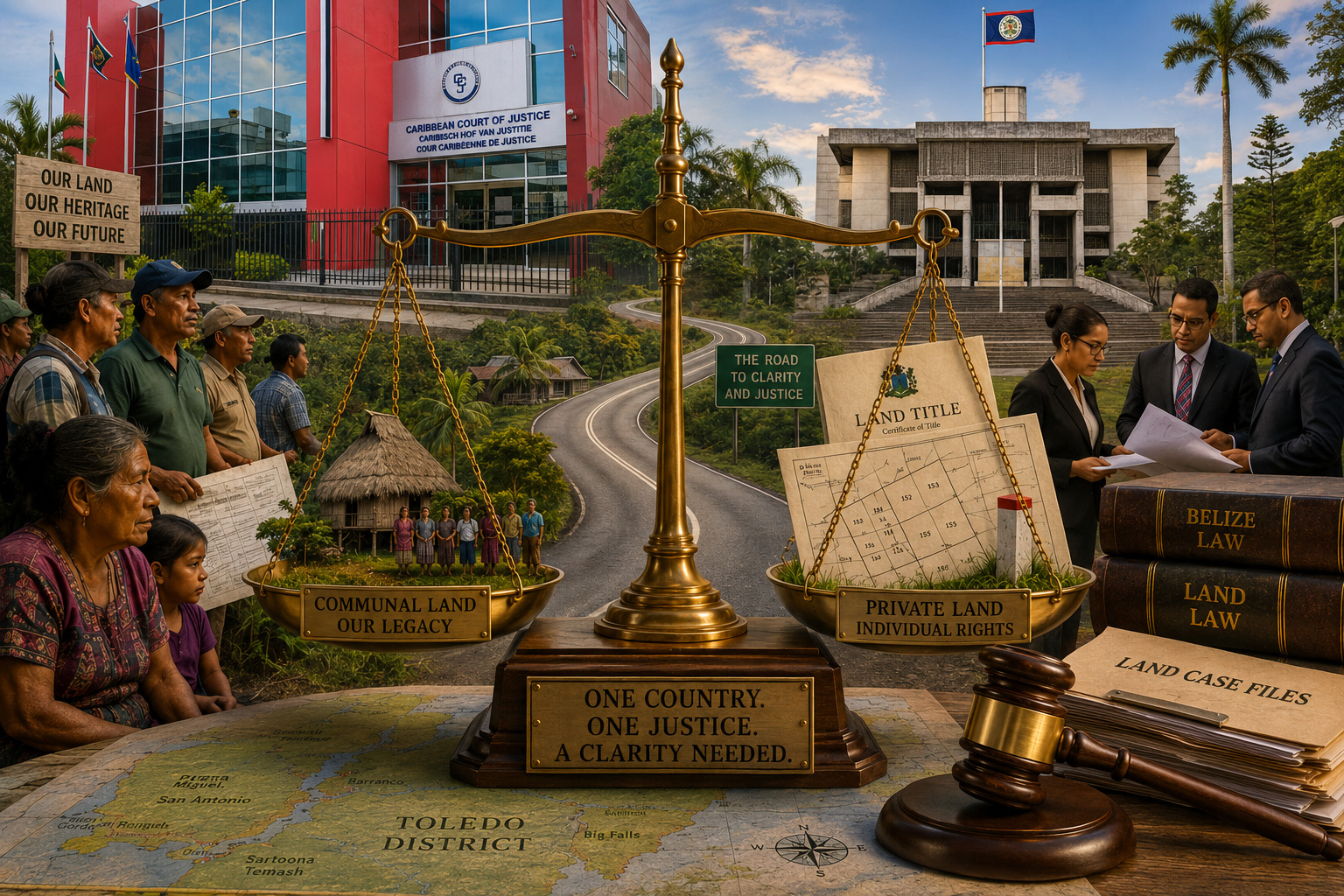
Belize City: Sunday 14th June 2026: For decades, the Maya Land Rights issue has occupied a unique place in Belize's legal and political history.
Governments have changed. Ministers have come and gone. Court rulings have been issued. International attention has come and gone. Yet the fundamental question remains remarkably similar to the one being asked twenty years ago:
When will the rights recognized by the courts become realities on the ground?
The latest chapter in that long-running story comes from the Government's decision to appeal the Jalacte compensation ruling to the Caribbean Court of Justice (CCJ).
According to Attorney General Anthony Sylvestre, the Government is not appealing because it rejects the principle that compensation should be paid. Instead, the appeal seeks clarification on what the Government describes as a potentially serious legal problem: the emergence of two separate compensation frameworks for land in Belize.
The Attorney General argues that compensation for communal land appears to be assessed differently from compensation for privately held land. If that interpretation stands, Belize could find itself operating under two distinct legal regimes for land compensation.
Viewed objectively, this is not an unreasonable concern.
Laws are expected to be consistent. Governments are expected to understand the financial implications of court decisions. Any administration, regardless of political party, would likely seek guidance from the country's highest court before allowing a new compensation formula to become entrenched as precedent.
If the issue is truly one of legal certainty, then an appeal to the CCJ may be entirely justified.
Yet there is another side to this discussion that cannot be ignored.
The Maya communities of southern Belize have spent decades pursuing recognition of rights that courts have repeatedly acknowledged. Each legal victory has often been followed by another stage of litigation, another administrative process, another consultation, another framework, another appeal, or another delay.
As a result, many Belizeans have become skeptical whenever a new legal challenge emerges after a major court ruling.
The question naturally arises:
Is this appeal about legal clarification, or is it another chapter in a process that has already consumed generations?
The answer may not be as simple as either side would like.
In truth, both concerns may be legitimate.
The Government may genuinely require guidance on whether Belize can operate under separate compensation frameworks for communal and private land.
At the same time, the practical effect of the appeal is undeniable: implementation is delayed until the CCJ speaks.
This is where the conversation becomes larger than Jalacte itself.
One statement made by the Attorney General deserves particular attention.
He warned that some privately held lands in Toledo could potentially be considered communal lands and that this could have serious legal and financial implications.
That observation reveals that this case is not merely about one village.
It is about the future relationship between communal land rights, private property rights, and the financial obligations of the Belizean State.
The stakes extend far beyond Jalacte.
The CCJ may ultimately be asked to determine whether communal land should be compensated in the same manner as private land, whether cultural and historical dimensions should influence valuation, and whether Belize can legally maintain different compensation standards for different categories of land.
The answers will shape Belizean land law for generations.
But there is another question that Belizeans should not lose sight of while lawyers debate legal formulas.
How many appeals, hearings, consultations, and judgments must occur before rights already recognized by the courts are fully implemented?
That is the question at the center of this controversy.
No reasonable person would deny the Government's right to seek clarification from the country's highest court.
Likewise, no reasonable person should dismiss the frustration of communities that have spent decades waiting for the practical implementation of decisions already handed down.
Perhaps the real issue is not whether there should be one compensation regime or two.
Perhaps the real issue is whether Belize has developed a habit of litigating difficult questions long after the courts have already answered the larger ones.
The CCJ will decide the law.
But the Belizean people must decide whether justice delayed continues to feel too much like justice denied.
"Why does implementation always seem to arrive years after recognition?"
By: Omar Silva – Editor/Publisher
National Perspective Belize – Digital
- Log in to post comments