MANY ROOTS, ONE NATION: "Unity, Sovereignty and Reconciliation in the Belizean Century".
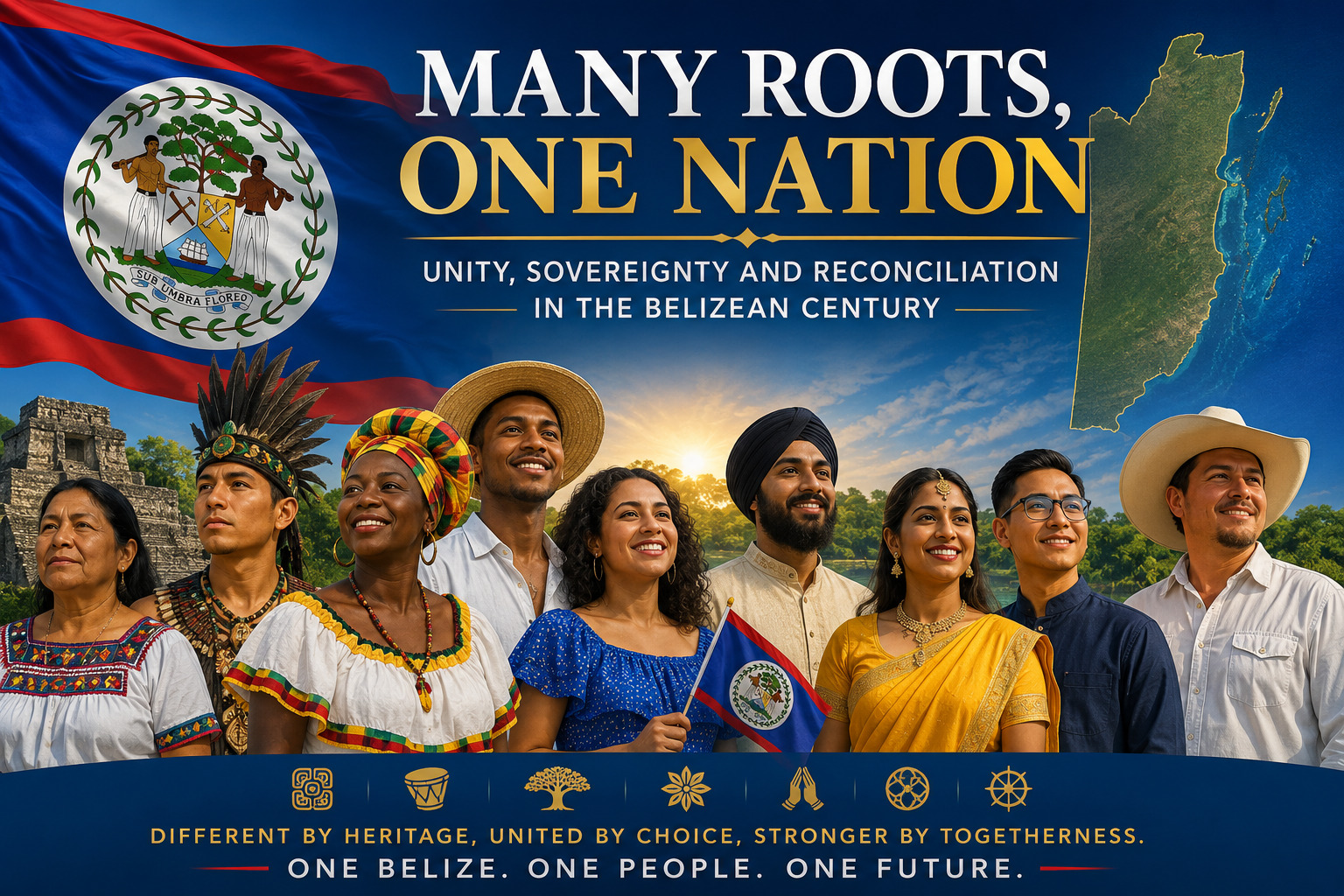
Special Feature:
Belize City: Friday 5th June 2026: Why Belize Must Choose Unity Over Division?
Belize is a nation unlike any other in the hemisphere.
Within our borders live descendants of the Maya, Garinagu, Creoles, Mestizos, East Indians, Mennonites, Chinese, Arabs, Europeans, and many others who have contributed to the development of this small but remarkable country. We speak different languages, celebrate different traditions, practice different religions, and trace our ancestral roots to different corners of the world.
Yet despite our diversity, we have always shared one common identity.
We are Belizeans.
In recent years, however, important discussions surrounding Indigenous rights, land tenure, cultural preservation, and historical recognition have increasingly occupied the national stage. These conversations are necessary and long overdue. No nation can move forward without honestly examining its history and ensuring justice for all its people.
But as these discussions evolve, Belize faces a critical question:
Can we recognize our differences without allowing those differences to divide us?
The answer must be yes.
The Maya Question and the Rule of Law
The Maya people possess a unique and ancient connection to the lands of southern Belize. Their presence predates colonial boundaries and modern governments. Their customs, traditions, and communal relationship with the land have survived centuries of change.
The courts of Belize and the Caribbean Court of Justice have recognized that Maya customary land rights deserve legal protection.
This recognition is not a gift.
It is a legal acknowledgement of historical realities and constitutional principles.
Yet this legal recognition should not be misunderstood as the creation of a separate nation within Belize. Nor should it be interpreted as granting exclusive ownership of Belize's sovereignty.
The issue before the nation has always been one of land tenure and legal rights, not political separation.
Belize remains one indivisible state.
The Emerging Garifuna Conversation
Today, another discussion is beginning to emerge.
Some members of the Garifuna community have raised questions regarding their own Indigenous identity, historical presence, and cultural rights.
The Garinagu are an extraordinary people whose history is marked by resilience, survival, and contribution. Arriving on the shores of Belize after exile from St. Vincent, they helped shape the cultural, economic, and social fabric of the nation.
Their language, music, traditions, and spirituality are treasures not only of Belize but of humanity itself.
Their desire for recognition deserves respect.
However, Belize must be careful not to confuse cultural recognition with territorial competition.
The path forward cannot become a contest over who arrived first, who suffered most, or who possesses greater historical entitlement.
That road leads not to justice, but to fragmentation.
The Dangerous Politics of Identity
Throughout the world, nations have struggled when politicians exploit ethnicity for political gain.
When citizens begin to see themselves primarily as members of competing ethnic groups rather than participants in a shared national project, trust erodes.
Communities become suspicious of one another.
National institutions weaken.
External forces find opportunities to exploit internal divisions.
Belize cannot afford such a future.
Not while poverty remains a challenge.
Not while economic transformation remains unfinished.
Not while questions of sovereignty continue to occupy national attention.
The Belizean people must never allow identity politics to become a substitute for nation-building.
One Sovereignty, Many Cultures
The true strength of Belize has never been uniformity.
It has been unity.
Belize has succeeded because generations of Belizeans chose coexistence over conflict.
Our diversity is not a weakness to be managed.
It is an asset to be celebrated.
The Maya should be free to preserve their customs and defend their lawful rights.
The Garinagu should be free to celebrate and protect their heritage.
The Creole community should continue preserving its profound cultural legacy.
Every ethnic and cultural group should enjoy equal dignity, equal opportunity, and equal protection under the law.
But none should be encouraged to view itself as separate from the national family.
Belize's future depends not upon dividing the country into cultural compartments but upon strengthening the bonds that unite us.
National Reconciliation in the Belizean Century
The next chapter of Belize's history should not be defined by ethnic competition.
It should be defined by national reconciliation.
A reconciliation that acknowledges historical grievances without creating new ones.
A reconciliation that protects cultural identity while strengthening national identity.
A reconciliation that embraces diversity while defending sovereignty.
Belize does not belong to one ethnicity.
Belize belongs to all Belizeans.
The blue, red, and white of our flag do not represent one people over another.
They represent a common destiny.
As our nation continues to mature, perhaps the most important question is no longer who came first.
The more important question is this:
What kind of Belize will we leave for those who come after us?
If the answer is a stronger, more united, and more sovereign nation, then the path forward is clear.
- Many roots.
- One people.
- One Belize.
- One future.
- Log in to post comments