WHEN THE SYSTEM RESISTS THE PEOPLE : The Jeremy Enriquez Redistricting Battle and Belize’s Growing Constitutional Crisis
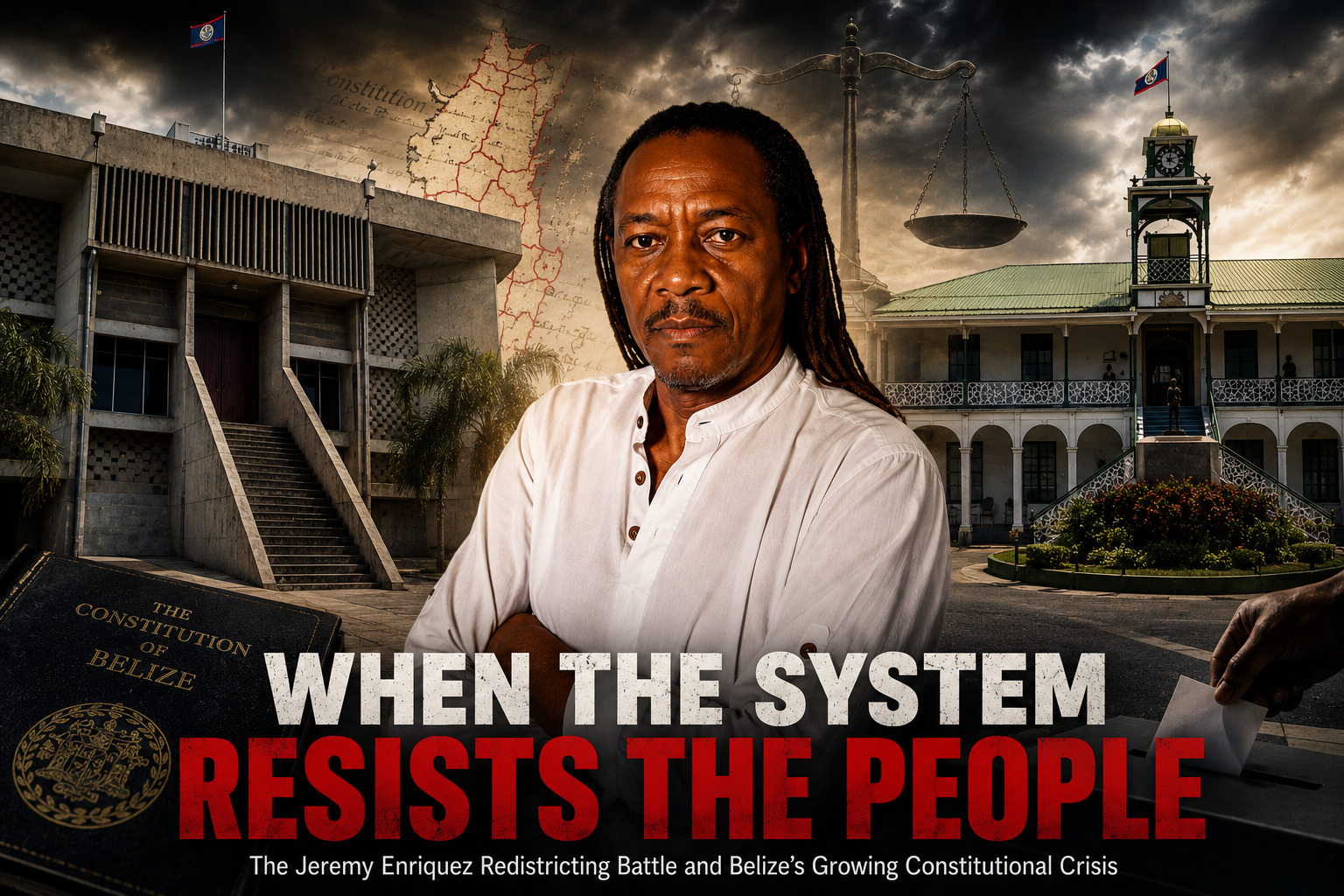
The Jeremy Enriquez Redistricting Battle and Belize’s Growing Constitutional Crisis
Belize City: Thursday, 28th May, 2026: Belize is once again being forced to confront a deeply uncomfortable question:
Is the justice system protecting the Constitution equally for all citizens, or is the machinery of State slowly becoming a shield for political convenience and institutional self-preservation?
That question now sits at the center of the long-running constitutional battle involving activist Jeremy Enriquez, electoral redistricting, judicial accountability, and the conduct of powerful state institutions that ordinary Belizeans increasingly view with suspicion.
What began as a constitutional challenge over Belize’s outdated electoral divisions has now evolved into something much larger — a national conversation about fairness, transparency, accountability, and whether democracy in Belize is functioning the way the Constitution originally intended.
And the latest court ruling should concern every citizen in this country.
FROM REDISTRICTING TO A CRISIS OF CONFIDENCE
The core of the issue is not complicated.
Belize’s Constitution requires electoral divisions to contain, “as nearly as may be,” equal numbers of eligible voters. The principle is simple: one citizen’s vote should not carry significantly more weight than another’s depending on where they live.
But for years, Belize has operated under electoral boundaries with enormous population imbalances.
Some constituencies have far smaller voter populations while others carry dramatically larger numbers, creating an uneven democratic structure where representation is distorted.
This is not merely political debate.
This is constitutional territory.
Jeremy Enriquez brought legal action challenging the legitimacy of proceeding with national elections under boundaries that many believe no longer reflect constitutional fairness.
His legal challenge sought to force the State to address what critics describe as years of deliberate political delay regarding redistricting reform.
Because the truth is uncomfortable for both major political parties.
Successive governments have spoken about reform while quietly benefiting from the existing imbalance.
And therein lies the deeper national concern.
THE HONDORA CONTROVERSY
The constitutional battle intensified when Justice Tawanda Hondora dismissed urgent applications tied to the redistricting challenge ahead of the March 2025 General Elections.
What followed generated enormous public concern.
Enriquez and his legal team later alleged judicial bias and misconduct after claims emerged involving discussions surrounding the case during a court break.
Although not every allegation was proven exactly as initially claimed, reports confirmed that discussions regarding the matter did occur, fueling public discomfort and further eroding confidence in judicial neutrality.
For many Belizeans, the issue was no longer simply about one judge.
It became symbolic of a wider fear:
That powerful institutions may be growing too comfortable operating without sufficient scrutiny or accountability.
SEVEN MONTHS OF SILENCE
The controversy deepened further after Enriquez filed a formal complaint before the Judicial and Legal Services Commission (JLSC).
According to the claim, the complaint was effectively left unanswered for over seven months.
Seven months without proper response.
Seven months without transparency.
Seven months during which a citizen seeking constitutional accountability was allegedly ignored by the very institution tasked with safeguarding judicial integrity.
That silence itself became the subject of litigation.
And this is where the latest ruling becomes nationally significant.
The High Court ruled against both the Attorney General and the JLSC, ordering them to pay Enriquez’s legal costs after finding that the Commission failed to properly address the matter in accordance with lawful expectations.
That ruling matters profoundly.
Because the court effectively signaled that institutions cannot simply bury public complaints through silence, delay, or procedural avoidance.
THE STATE VERSUS THE CITIZEN
Perhaps most troubling to many observers was the reported attempt by the Attorney General’s side to seek legal costs against Enriquez himself.
To ordinary Belizeans, this creates a disturbing appearance.
A citizen raises constitutional concerns.
The State deploys its immense legal machinery against him.
Taxpayer-funded attorneys then attempt to financially punish the citizen for demanding accountability from taxpayer-funded institutions.
Whether legally permissible or not, the optics are politically devastating.
Because many Belizeans already feel the justice system favors those with power, connections, influence, and resources.
The average citizen watching these events unfold cannot help but ask:
If this is how a nationally known activist is treated publicly, what happens quietly to ordinary Belizeans without visibility, attorneys, media attention, or financial resources?
THE DEEPER CONSTITUTIONAL QUESTION
The Enriquez litigation has now evolved beyond one activist, one judge, or one case.
It has exposed a growing national anxiety surrounding the integrity of Belize’s democratic institutions.
The issue touches several dangerous fault lines simultaneously:
- Electoral fairness
- Judicial accountability
- Separation of powers
- Institutional transparency
- Political influence
- Public confidence in democracy
And beneath it all lies a larger truth that Belize continues struggling to confront honestly:
The political culture inherited from the colonial era remains heavily centralized around executive power, party dominance, and institutional control.
Successive governments often behave as though electoral victory grants near-unlimited authority over state institutions.
But constitutional democracy was never designed to function that way.
The judiciary exists precisely to restrain excesses of political power.
Independent commissions exist to ensure accountability.
And the Constitution exists to protect citizens from institutional abuse — not to shield institutions from citizens.
THE PEOPLE ARE WATCHING DIFFERENTLY NOW
What makes this period historically important is that Belizean society itself is changing.
Citizens are becoming less fearful of questioning authority.
More Belizeans are openly discussing constitutional rights, judicial conduct, abuse of process, political interference, and democratic reform.
Social media, independent media platforms, and growing public frustration with traditional politics are accelerating this transformation.
The old culture of silence is weakening.
The younger generation especially is becoming increasingly unwilling to accept:
“Just leave it so.”
“That is how Belize works.”
“Nothing can change.”
That mentality is dying slowly.
And the Enriquez litigation has become one of the clearest examples of that national awakening.
A SYSTEM UNDER PRESSURE
The real danger for Belize is not criticism itself.
Healthy democracies survive criticism.
Healthy democracies survive constitutional challenges.
Healthy democracies survive public scrutiny.
The real danger emerges when institutions begin appearing defensive, politically sensitive, selective, dismissive, or insulated from accountability.
Because once public trust in institutions collapses, rebuilding legitimacy becomes extraordinarily difficult.
And right now, Belize is entering dangerous territory where increasing numbers of citizens no longer fully trust:
- the electoral structure,
- the political system,
- sections of the judiciary,
- constitutional enforcement mechanisms,
- or the sincerity of governance itself.
That erosion of confidence should alarm every serious national leader regardless of political affiliation.
THE CONSTITUTION MUST MEAN SOMETHING
At its core, this entire battle comes down to one principle:
Does the Constitution apply equally to everyone — including the State itself?
Or does constitutional enforcement depend on political convenience?
That is the real question Belize now faces.
Because a constitution that cannot restrain power eventually becomes symbolic rather than functional.
And democracy without institutional trust slowly transforms into managed political theater.
The Belizean people deserve far better than that.
They deserve electoral fairness.
They deserve transparent institutions.
They deserve judicial accountability.
And above all, they deserve a system that remembers one fundamental truth:
In a democracy, the institutions belong to the people — not the other way around.
By: Omar Silva – Editor/Publisher
National Perspective Belize – Digital
- Log in to post comments