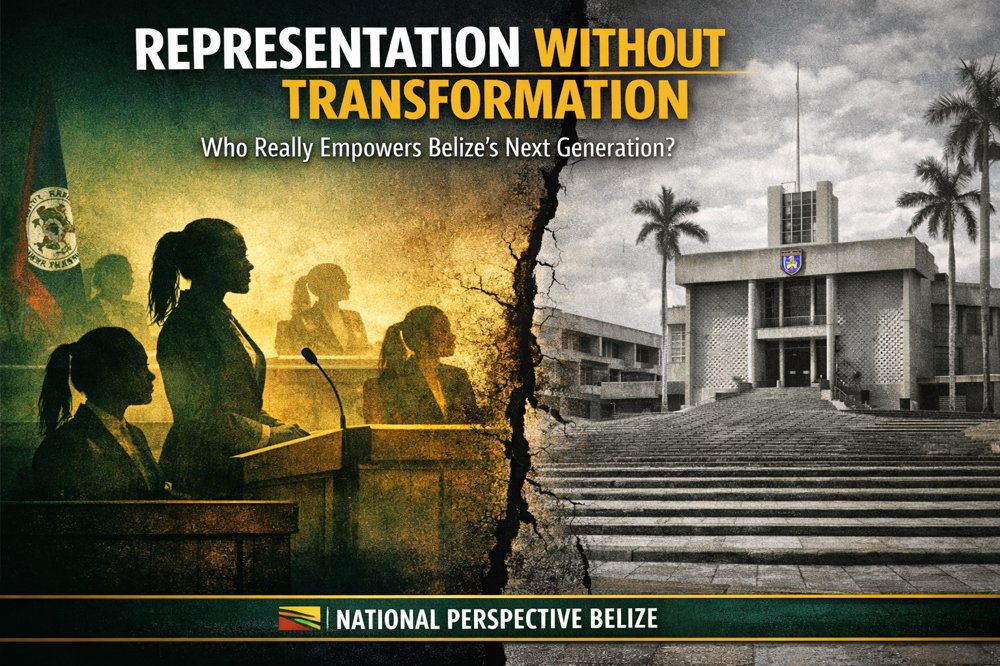
“Representation Without Transformation: Who Really Empowers Belize’s Next Generation?”
By: Omar Silva I Editor/Publisher
National Perspective Belize – Digital 2026
Belize City: Sunday 22nd March 2026
📰 FEATURE ARTICLE
In Belize today, the language of empowerment is everywhere.
It is spoken in Parliament.
It is echoed in classrooms.
It is celebrated on social media.
And most recently, it was championed by Tracy Taegar Panton in her address supporting young women participating in a Mock Parliament at the National Assembly—an initiative that, on the surface, reflects progress, inclusion, and hope.
But beneath the applause, Belizeans must ask a more difficult question:
Is representation alone enough to transform a nation that has remained structurally unchanged since Independence?
⚖️ The Illusion of Progress
There is no debate—women must be part of leadership.
Their voices, perspectives, and contributions are not optional; they are essential.
But Belize’s crisis is not a crisis of who sits at the table.
It is a crisis of:
- What the table represents
- Who built it
- Whose interests it continues to serve
For decades, both major political parties—the People’s United Party (PUP) and the United Democratic Party (UDP)—have operated within the same inherited framework:
- A colonial governance structure
- An import-dependent economic model
- A political financing ecosystem tied to entrenched interests
The result?
A system that recycles leadership but never redefines direction.
🧭 Different Faces, Same System
The rise of a female Leader of the Opposition is historic.
But history alone does not guarantee transformation.
Because if the system remains:
- Economically dependent
- Politically captured
- Structurally stagnant
Then leadership—regardless of gender—becomes symbolic, not strategic.
Belizeans have seen this before:
- New leaders
- New promises
- Same outcomes
And now, even as empowerment is being promoted, questions emerge about continuity rather than change—especially in light of ongoing interactions between political figures and influential financiers such as Michael Ashcroft, whose role in shaping Belize’s political landscape is widely recognized.
This is not accusation.
This is reality.
And it raises a fundamental national concern:
Can a system funded by the same interests produce a different future?
🔍 Empowerment Without Mechanism
The language of empowerment is powerful—but it must be matched with structure.
When young women are told:
- “Your voice matters”
- “Step forward and lead”
The natural follow-up question is:
Lead what—and toward what end?
Because empowerment without:
- Economic opportunity
- Institutional reform
- Access to capital
- Policy-driven inclusion
…is not empowerment.
It is encouragement without infrastructure.
🏗️ What Real Empowerment Requires
If Belize is serious about empowering the next generation—women and men alike—then the conversation must shift from participation to transformation.
Real empowerment demands:
1. Economic Independence
- Moving beyond import dependency
- Building local industry and manufacturing
- Creating ownership opportunities for Belizeans
2. Political Deconstruction
- Breaking the cycle of elite-controlled financing
- Establishing transparent, accountable governance
- Redefining the role of the state beyond colonial inheritance
3. Ideological Clarity
- A defined national doctrine
- A clear development model
- A long-term transformation strategy
Without these, empowerment remains aspirational—not operational.
🔥 The Generational Crossroads
- Belize is not lacking in talent.
- It is not lacking in ambition.
- It is not lacking in young women ready to lead.
What Belize lacks is a system worthy of their leadership.
Because placing a new generation into an old framework does not produce change.
It produces:
- Frustration
- Disillusionment
- Migration
🧠 The Question That Cannot Be Avoided
So as Belize celebrates representation—and it should—the country must also confront a harder truth:
Will the next generation inherit the system… or will they be empowered to rebuild it?
Because:
- A woman in a broken system
- A man in a broken system
…does not fix the system.
🪶 Conclusion: Beyond Symbolism
Belize does not need empowerment narratives alone.
It needs empowerment architecture.
And until leadership—on both sides of the political aisle—moves beyond symbolism into structural reform, the next generation will not inherit a future.
They will inherit a continuation.
- Log in to post comments