BELIZE'S ECONOMIC REALITY CHECK: THE PAST, THE PRESENT, AND A CAUTIOUS FUTURE
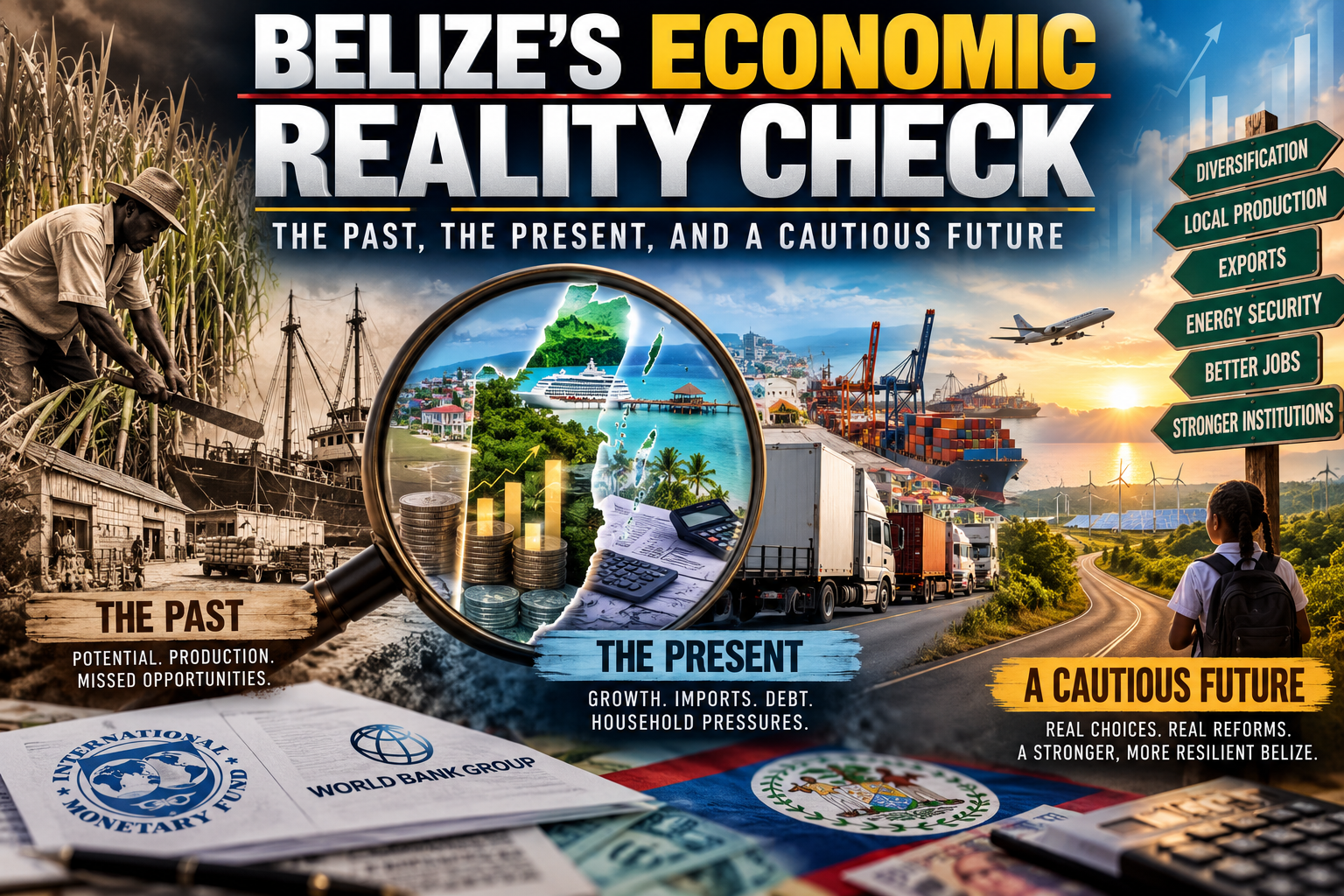
Beyond GDP growth, international financial meetings and reassuring economic statistics lies a fundamental national question: Is Belize building an economy capable of sustaining its own prosperity—or merely learning to manage its dependency?
INTRODUCTION — WHEN THE NUMBERS LOOK BETTER THAN THE STRUCTURE
Belize City: Tuesday 13th October 2026: There is a moment in the economic life of every developing nation when its people must distinguish between progress that can be measured and transformation that can be sustained.
Belize has reached a point where that distinction deserves serious public examination.
The national conversation is frequently dominated by economic growth, tourism performance, public debt reduction, investment announcements, government revenues and international financial partnerships.
- These are legitimate indicators of economic activity. They matter. They should not be dismissed.
- But they do not, individually or collectively, answer the larger question of whether Belize is becoming economically stronger at its foundations.
A country can experience rising GDP while remaining heavily dependent on imported consumer goods.
- It can welcome more tourists without developing sufficient domestic industries to supply its tourism sector.
- It can reduce its debt-to-GDP ratio while households continue struggling with food prices, housing, electricity, transportation and the cost of raising a family.
- And it can attract foreign investment without necessarily retaining a corresponding share of the wealth generated within its borders.
Economic growth is not automatically economic transformation.
That is the distinction National Perspective Belize intends to examine.
- This is not an argument that Belize's economy is collapsing. Nor is it an assertion that positive economic statistics are fabricated.
- It is an examination of whether the country's economic achievements are sufficiently deep, diversified and productive to withstand the pressures of an increasingly uncertain international environment.
The IMF and World Bank meetings in Bangkok provide a timely occasion for that examination.
- But Belize's economic questions did not begin in Bangkok.
They began decades earlier.
I. THE PAST — A COUNTRY RICH IN POTENTIAL, BUT SLOW TO INDUSTRIALIZE
- Belize entered independence in 1981 with substantial agricultural resources, established export industries and a strategic geographic position between Central America and the Caribbean.
- Sugar, citrus, bananas, fisheries and other agricultural activities provided an important foundation for foreign exchange earnings.
- But independence brought an economic challenge alongside the political achievement of nationhood.
How would Belize move beyond the production and export of primary commodities toward a diversified economy with greater domestic processing, manufacturing and technological capacity?
- More than four decades later, that question remains relevant.
- Agricultural exports have continued to matter. Tourism and services have expanded significantly. Belize has developed new sources of employment and international economic activity.
These achievements deserve recognition.
- Yet the historical record also invites a difficult examination of the country's industrial development.
- How much of the value of Belizean agricultural production is captured domestically?
- How many opportunities exist to transform locally produced raw materials into higher-value products?
- How effectively have successive administrations supported the infrastructure, financing, technical skills and market access needed for competitive industries?
- And why has the development of domestic production remained such a persistent national policy concern?
These are questions for successive governments, not simply the present administration.
- Political independence established Belize's right to determine its economic destiny. Economic development remains the continuing task of building the capacity to exercise that right.
II. THE PRESENT — WHAT THE IMF'S OWN NUMBERS REVEAL
The International Monetary Fund's September 2025 Article IV consultation provides an unusually useful starting point for evaluating Belize's economic position.
The IMF reported that real GDP expanded by 8.1% in 2024, driven particularly by tourism, trade and transportation.
- It also reported a significant improvement in public debt, which declined from 103.3% of GDP in 2020 to 61.1% in 2024. Debt restructuring arrangements contributed to that reduction.
These are meaningful developments, and a credible economic analysis must acknowledge them.
- But the same IMF assessment projected growth slowing to 1.5% in 2025 and converging toward approximately 2% over the medium term without further expansion of productive capacity, including tourism infrastructure. These were forecasts, not confirmed 2025 or 2026 outcomes.
That contrast deserves national attention.
The central issue is not whether Belize experienced an economic recovery.
It did.
- The question is whether that recovery has established the foundations for sustained productivity growth, greater economic diversification and broader household prosperity.
- A strong recovery from an extraordinary economic contraction is not necessarily evidence of a permanent increase in an economy's productive potential.
- Indeed, the IMF has repeatedly emphasized structural reforms, improved access to financing, competitiveness, infrastructure and greater resilience to external shocks.
III. THE IMPORT ECONOMY — WHO PRODUCES WHAT BELIZE CONSUMES?
Consider the ordinary Belizean household.
- Food, household supplies, fuel, transportation, construction materials, appliances and many everyday necessities connect Belizean consumers to international supply chains.
- Imports are not inherently undesirable. Every modern economy imports goods it cannot efficiently produce, and international trade can improve living standards.
- The problem arises when a country's import requirements expand faster than its capacity to earn foreign exchange, develop competitive local industries or withstand external price shocks.
- For Belize, the important questions are therefore not simply how much the country imports, but what it imports, why it imports those products, and which categories could be competitively supplied or processed domestically.
- Can Belize strengthen food-processing industries?
- Can farmers gain more reliable access to processing facilities, storage, transport and regional markets?
- Can tourism establishments purchase a greater share of competitively priced Belizean products?
- Can renewable energy investments reduce exposure to imported fuel and electricity costs?
- And can local entrepreneurs obtain financing on terms that allow them to compete?
These questions require sector-by-sector analysis rather than blanket import restrictions.
- A successful industrial strategy would have to consider scale, production costs, quality, regional trade rules, environmental sustainability and consumer prices.
- Replacing imports with expensive or unreliable domestic products would not automatically improve national welfare.
The objective should be competitive domestic production, not economic isolation.
IV. THE HOUSEHOLD REALITY — GDP IS NOT A FAMILY BUDGET
- One of the most important distinctions in economic reporting is the difference between national output and household welfare.
- GDP measures the value of goods and services produced within an economy.
- It does not directly measure how income is distributed, how much households can save, whether wages keep pace with prices, or whether families can afford adequate housing and essential services.
Similarly, a decline in inflation does not ordinarily mean that prices have returned to previous levels. It means that prices are increasing more slowly.
- Belizeans may therefore experience improvements in national economic statistics while continuing to face financial pressure.
- A complete reality check should compare wages, household expenditure, food prices, housing costs, electricity, transportation, poverty and employment quality over consistent periods.
It should also recognize positive developments where supported by the evidence.
- For example, the IMF's 2025 consultation recorded an unemployment rate of 2.1% in April 2025 and multidimensional poverty of 22.1% in 2024. These indicators measure different aspects of economic and social conditions and should not be treated as interchangeable.
- The essential question is whether growth is translating into durable improvements in living standards across Belize's districts and communities.
V. BANGKOK — THE WORLD IS DISCUSSING RISKS BELIZE CANNOT IGNORE
The IMF and World Bank Annual Meetings, taking place in Bangkok from October 12–18, arrive during a period of considerable global economic uncertainty.
The international discussion includes debt sustainability, development financing, energy costs, technological change, investment and employment.
- On October 13, Reuters reported that developing countries face mounting debt-servicing pressures and that G24 is calling for more accessible concessional financing.
The IMF's latest global outlook also identifies risks associated with geopolitical conflicts, energy prices and public debt.
- For Belize, these are not distant academic concerns.
- Higher international energy prices can increase domestic transportation and production costs.
Expensive borrowing can constrain public investment.
- Weak external demand can affect tourism and exports.
- Natural disasters can destroy infrastructure and disrupt livelihoods.
- And technological changes may create opportunities for economies with the skills and infrastructure to participate, while widening the gap for those without them.
Yet attendance at an international meeting does not, by itself, establish that Belize has secured financing, negotiated reforms or committed to new obligations.
Those questions must await verified Belize-specific disclosures.
- National Perspective Belize will examine them separately in its pending IMF Recommendations Accountability Review.
VI. THE CAUTIOUS FUTURE — WHAT WOULD TRANSFORMATION ACTUALLY REQUIRE?
Belize's future economic resilience cannot depend exclusively on the performance of any single industry or the availability of external financing.
- A more diversified economy would require sustained attention to agricultural productivity, agro-processing, energy security, technical education, logistics, manufacturing, digital services and export development.
- It would also require credible public institutions, transparent procurement, effective infrastructure maintenance and predictable investment rules.
There are genuine trade-offs.
- Fiscal discipline is necessary to prevent unsustainable debt.
- But reducing public expenditure without protecting essential infrastructure and human development can weaken future growth.
- Foreign investment can provide capital, technology and employment.
- But investment agreements should be evaluated for their long-term benefits, costs, public obligations and contributions to domestic economic capacity.
Domestic investment can strengthen local ownership.
But Belizean enterprises also need competitive financing, dependable infrastructure, skilled workers and access to markets.
- There is no credible transformation program that can avoid these practical questions.
- Nor can any government promise that Belize will become self-sufficient in every product or immune to global shocks.
The realistic objective is a more resilient, productive and inclusive economy—one capable of generating greater value domestically while participating competitively in regional and international markets.
VII. THE QUESTIONS BELIZE MUST ANSWER
The national economic conversation should now move beyond whether GDP increased or decreased in a particular quarter.
- It should examine what is driving that growth and whether its benefits can endure.
- Are productive industries becoming more competitive?
- Are export opportunities expanding?
- Is infrastructure improving economic efficiency?
- Are workers acquiring skills that command higher earnings?
- Are households experiencing measurable improvements in purchasing power?
- Is public borrowing financing investments capable of generating lasting economic and social returns?
- And are the country's economic institutions sufficiently strong to sustain progress beyond individual administrations?
These are not questions that belong exclusively to government, opposition parties, economists or international financial institutions.
- They concern every Belizean whose future depends on the country's economic direction.
CONCLUSION — THE ECONOMY WE INHERITED, THE ECONOMY WE HAVE, AND THE ECONOMY WE MUST BUILD
Forty-five years after independence, Belize has achievements worth acknowledging but also, structural challenges that remain unresolved.
- Its tourism industry has expanded. Its economy recovered strongly following the pandemic. Public debt indicators improved substantially from their 2020 levels.
- But none of these developments eliminates the need to examine productive capacity, competitiveness, household welfare and long-term resilience.
The past offers lessons about the consequences of delayed diversification and dependence on a narrow range of economic activities.
- The present offers evidence of both progress and vulnerability.
- The future demands careful choices rather than comforting assumptions.
The meetings in Bangkok may produce useful opportunities for Belize. Their actual significance will depend on what is agreed, how it is implemented, and whether the resulting policies improve the country's economic foundations.
National Perspective Belize therefore leaves its readers with one fundamental reflection:
- If Belize's economy is growing, how much stronger is Belize becoming?
That question cannot be answered by GDP alone.
- It requires examining the industries we build, the opportunities we create, the institutions we strengthen, the prosperity households experience, and the resilience we leave to the next generation.
- The purpose of an economic reality check is not to deny progress. It is to determine whether progress is becoming permanent.
NATIONAL PERSPECTIVE BELIZE
Independent Analysis | Economic Accountability | October 2026
By: Omar Silva – Editorial Director @ www.nationalperspectivebz.com
Next investigation: THE IMF RECOMMENDATIONS: WHAT HAS BELIZE IMPLEMENTED, AND WHAT REMAINS UNFINISHED?
Principal documentary foundation: IMF 2024 and 2025 Article IV consultations; IMF and World Bank 2026 Annual Meetings programme; Reuters reporting of October 13, 2026. Current trade, wage and household-cost figures should be checked against the latest official Belize statistics before publication.
- Log in to post comments